Good solutions were sent in by Thomas Lauffenberger, Angus Balkham of Bexhill College and Andrei Lazanu of School No. 205, Bucharest, Romania.

Here is Andrei's soluton:

Two things are to be observed for solving this problem:

1) the angle $\alpha$ between two vectors ${\bf a}$ and ${\bf b}$ can be determined from their scalar product as follows: $$\cos \alpha = {{\bf a}.{\bf b}\over ab}$$ where a and b are the moduli of the vectors.

2) On Earth approximated with a sphere, if one knows the latitude and longitude of a point (city), the vectors with the origin in the centre of the Earth and ending in the respective city are completely determined.

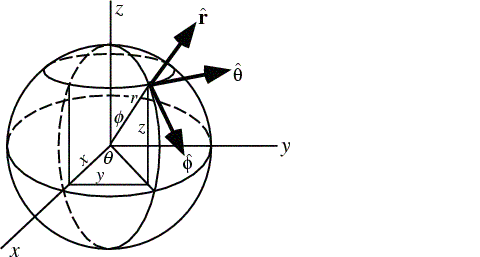
The position on a sphere is usually described using the spherical coordinates: - the azimuthal angle, the angle in the xOy plane, and, the polar angle, from the z axis, as illustrated below:Global angles On the sphere r is fixed, and I'll first work on the unit sphere. For the problem, the azimuthal angle gives the longitude, while the polar angle is (90o - latitude).

The relation between the spherical coordinates and the Cartesian ones on the unit sphere is:
x=cosqsinfy = sinqsinfz = cos f.
For London, angle q is (90o - 52o), i.e. 380 and angle f is 0°. So, its coordinates are:
x1 = sin38o cos0o = sin38oy1 = sin38o sin0o = 0,  z1 = cos38o.
For Cape Town angle f is 90o + 34o = 124o and angle q is 18o. Its coordinates are:
x2 = sin56o cos18oy2 = sin56o sin18oz2 = cos124o = -cos56o.

The scalar product of the two vectors characterised by their Cartesian coordinates:
®
OA
 
=x1i+y1j + z1 k

and
®
OB
 
=x2i+y2j + z2k

is
®
OA
 
· ®
OB
 
= x1x2+y1y2+z1z2.
The product of the vectors corresponding to London and Cape Town is:
®
OL
 
· ®
OC
 
= sin38o sin56o cos18o - cos 38o cos56o = 0.0447754018.

So, if angle LOC has its cosine value 0.0447754018, then its measure is 87.43370046o.

Each two points of a sphere are on a big circle of the sphere, having as centre the centre of the sphere. The angle between these points is the angle determined above.

The circumference of the Earth (considering it is a sphere) is: 2p×6367 km

This value corresponds to 360o. So, to the angle 87.43370046o corresponds the following distance in kilometres:
87.43370046
360
×2p×6367 = 9716.079
which we round to 9716 km.

I looked in Encarta and I found that the distance between the two cities is 9689 km, so the approximation is very good.

The distance traveled by the plane is a circular arc, with radius 6373 km. Applying a similar procedure, I observe that the plane traveled 9725.2359 km.

The formula for obtaining the speed is v = d/t, where d is the distance and t - the time. So, the average speed is 884 km/h (to 3 significant figures), a value that is again reasonable.