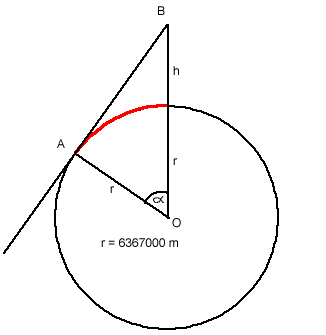
The solution below is based on the one sent in by Barinder of
Langley Grammar School. We had quite a number of correct, well
laid out solutions to this problem this month including those
from Roy of Allerton High School, Dan (no address given) and
Calum of Wayland High School. 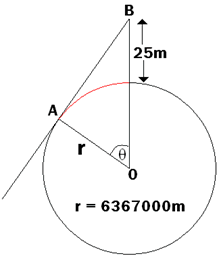
Although definitely not in proportion, this makes the problem seem
a lot easier. The question is asking for the length of the arc I
have coloured red. To get this, I decided to find the angle
on the
diagram, and use the equation
Arc Length
where
is measured in degrees and r is the radius
, since it is where a tangent and a radius of a circle
meet - it is a circle theorem.
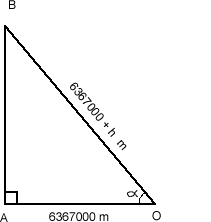
Thus, the triangle AOB can be drawn as follows:
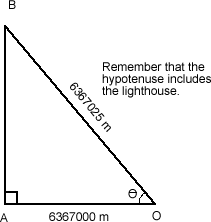
We can now use trigonometry to find
:
(4.d.p)
Substitute this into the equation for the arc length of a circle
earlier to obtain the length required:
For this next part, we are given the arc length, since this
corresponds to the distance between England and France. The
diagram is therefore:
This is essentially the reverse of the
previous question. We need to find the angle
first, and to do
this, we consider the arc length of the sector OAD of the circle: Arc Length
.
So
Since we now have the angle
, we can consider the triangle AOB:
.
So
.
So
m high.
Thus, the cliffs of Dover are 80.4 metres high.