Thomas sent in the solution below. We also received a correct
solution from Andrei of School 205 Bucharest as well as a number of
partial solutions.
The description of the thirteen axes of revolution are as
follows:
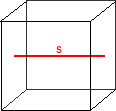
- three of them penetrate the cube through the
centre of a given face and exit through the centre of the opposite
face (using a die as an example, through the 1 and 6, 2 and 5, and
3 and 4;
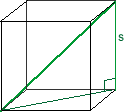
- four of them penetrate the cube through a given
vertex and exit through the opposite vertex (if the cube were to be
stood on a vertex, it would exit through the one on top);
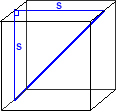
- the other six enter the cube through the midpoint
of a given edge and exit through the midpoint of the opposite edge
(if the cube were stood on edge, it would exit through the midpoint
of the top edge).
As for the mean length of the axes, the three axes through the
faces have the same length as an edge (call that length
s).
The six edge axes have a length equal to the diagonal of a
face, or
s ×Ö2
and the four vertex axes, the hypotenuses of right triangles
with sides of
s
and
s ×Ö2
, have length:
s ×Ö3 .
.
Summed up, the average axis length is:
.