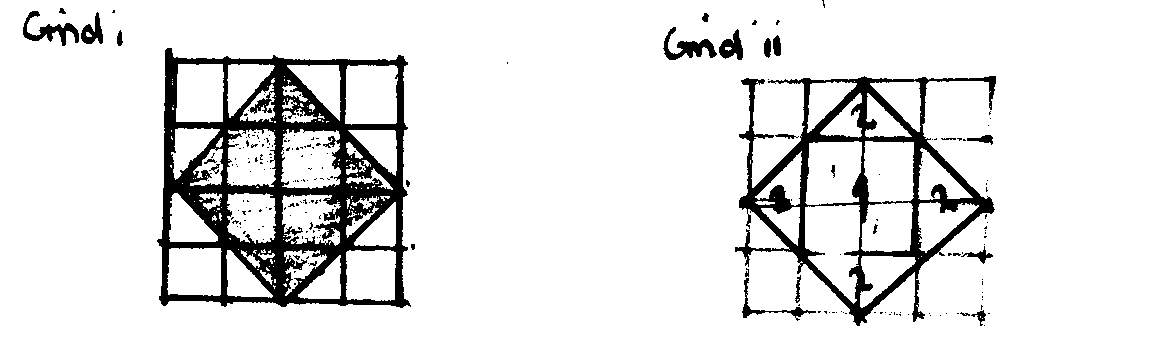
| along | up | area of upright square + | (number of triangles | x area of triangle) | = area of titled square |
| 1 | 1 | 0 | 4 | 1/2 | 2 |
| 2 | 1 | 1 | 4 | 1 | 5 |
| 3 | 1 | 4 | 4 | 1 1/2 | 10 |
| 4 | 1 | 9 | 4 | 2 | 17 |
| 5 | 1 | 16 | 4 | 2 1/2 | 26 |
| 6 | 1 | 25 | 4 | 3 | 37 |
| 7 | 1 | x2 +4 | 4 | n/2 | a (area) |
| (n - 1)2 + (4 × |
1 2 | n) = a |
| x | 1 | 2 | 3 | 4 | 5 | 6 | x |
| area | 2 | 5 | 10 | 17 | 26 | 37 | x2 +1 |
| along | up | area of upright square + | (number of triangles | x area of triangle) | = area of tilted square | ||
| 1 | 2 | 1 | 4 | 1 | 5 | ||
| 2 | 2 | 4 | 4 | 1 | 8 | ||
| 3 | 2 | 1 | 4 | 3 | 13 | ||
| 4 | 2 | 4 | 4 | 4 | 20 | ||
| 5 | 2 | 9 | 4 | 5 | 29 | ||
| 6 | 2 | 4 | 4 | 6 | 40 | ||
| n | 2 | ? | 4 | n | a (area) |
n is not easy to find here because there is no regular pattern in the "area of an upright square column". I will now try and find a pattern in the numbers of areas.
| x | 1 | 2 | 3 | 4 | 5 | 6 | x |
| area | 5 | 8 | 13 | 20 | 29 | 40 |
Therefore the area of a "2 up" tilted sqaure is equal to
But wait a minute...
could the formula for "3 ups" possibly be
Could "4 ups" be
Using this formula we could also find what areas are not "2 up" tilted squares. Let's take the number 260
Now let's try 580
Let's look at the pattern for the area of "3 ups"
| x | 1 | 2 | 3 | 4 | 5 | 6 | x |
| area | 10 | 13 | 18 | 25 | 34 | 45 |
Let's see "4 ups"
| x | 1 | 2 | 3 | 4 | 5 | 6 | x |
| area | 17 | 20 | 25 | 34 | 45 | 58 |
This proves that to be an area of a titled square, the number must be the sum of two square numbers.
= area of a tilted squareIf you were also only given the numer along and number up you could find the area because
number along2 + number up2 = areaThis can be proved by Pythagoras' theorem.
------------------------------------------------------------------------------------------------
n across, 1 up set produces squares with areas of
n2+ 1A square whose area is 122 square units has an 11 across, 1 up base
and a square whose area is 2501 square units has a 50 across, 1 up base.
n across, 2 up set produces squares with areas of
n2+ 4A square whose area is 260 square units has an 16 across, 2up base
and a square whose area is 580 square units has a 24 across, 2up base.
n across, 3 up set produces squares with areas of
n2+ 9n across, x up set produces squares with areas of
n2+ x2