Thanks to Andrei of School 205 Bucharest for this well explained
solution.
- First, I drew a line
, perpendicular on
, and a line
through H, parallel with
.
-
On it, I took a segment
of the same length with
.
-
Then I finished drawing the square
, drawing
perpendicular on
. The line PE intersects
in
.
- From
I drew a parallel to
(let the intersection
point with
be
), and a perpendicular to
(let the
intersection point with
be
).
- This way I found 3 vertices of the rectangle
, and I
finished the rectangle finding the vertex
on
, so that
is perpendicular to
.
The rectangle
is a square because:-
Triangles
and
are similar, they are both right-angled
triangles, with a common angle. The similarity ratio is:
Triangles
and
are similar, because angles
and
are equal and
is a common angle. The similarity ratio
From
and
As
(sides of a square)
Therefore
is a rectangle with two adjacent sides equal
Therefore
is a square.
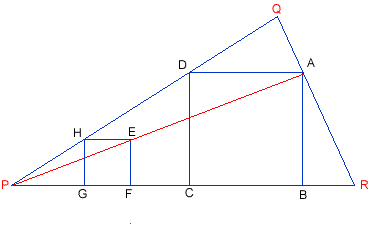 Now, the construction of the inscribed square must be done in
the following steps:
Now, the construction of the inscribed square must be done in
the following steps:
- Chose a point
on side
, near
- Draw line
, perpendicular on
- Take the
distance
as the compass distance, and draw a circle arc, with
centre
.
is the point of intersection of this arc with
.
-
Construct two circle arcs with centres
and
(with the same
radius as before). Their intersection is point
, and
is
a square.
-
Draw line
. Let the intersection point of this line with side
be
.
- Draw from
parallel to
and
. Their
intersections with
and
are points
and
respectively.
- Draw from
a parallel to
. Its
intersection with
is
.
-
is the square to be
found.
Note The choice of point
, so that
is interior to the
triangle
is not a restrictive condition, the construction is
the same if
is exterior to triangle
.