Congratulations Andrei Lazanu, age 14, of School
No. 205, Bucharest, Romania for this excellent
solution.
I looked at the images of points (1, 0) and (0,
1) respectively, under the transformation by the
matrix
This means that under this transformation, the
point (1, 0) maps to the point
.
Under this transformation, the point (0,1) maps
to the point
.
Now, I look at the effect on the plane of the
four transformations:
1.
This means each point (x, y) transforms into its
symmetrical image with respect to the origin,
i.e. into the point (-x, -y). This is a rotation
of 180 degrees about the origin.
2.
Here, it is a reflection in the y-axis.
3.
In this situation each point transforms into
itself.
4.
This transformation leaves the abscissa unchanged
and modifies the sign of the ordinate, being a
reflection in the x-axis.
Now, I look at the next set of transformations.
5.
In this transformation, the abscissa and the
ordinate are interchanged, the transformation
being a reflection in respect to the line
,
the angle bisector of the first quadrant.
6.
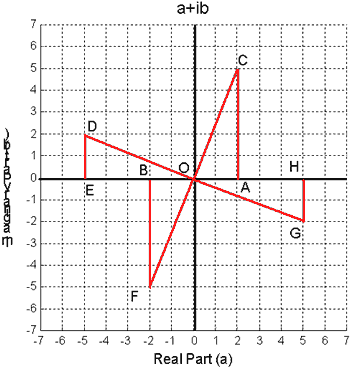
Looking to the solution to 'Complex Rotations'
from the NRICH +15, July 2003, I see that this
comes to the transformation of point C into point
G: here the plane is complex, on the abscissa
there is the real part, and the ordinate the
imaginary one, but in fact the things are
completely similar. This is a rotation of 270
degrees anti-clockwise about the origin.
The lines CF and DG are perpendicular. All four triangles are
congruent, because they are all right-angled triangles and all have
two congruent sides.
7.
This corresponds to a reflection in the line
.
8.
This corresponds to a rotation of the point by 90
degrees anti-clockwise about the origin.
The difference between the transformations (5 -
8) and the transformations (1 - 4) is that not
only the signs are changed, but a reversal of the
x and y coordinates takes place simultaneously.
I start to analyse the effect of these
transformations on the unit square with vertices
(0,0), (0,1), (1,1), (1,0). By observing what
happens to the two points A(1,0) and B(0,1) we
can see what happens to the whole square which
moves rigidly with the edges OA and OB. All the
points in the plane are transformed in the same
way as the unit square.
1) The matrix
maps (1,0) to (-1,0) and (0,1) to (0,-1), a rotation of 180 degrees about the origin.
2) The matrix
maps (1,0) to (-1,0) and (0,1) to (0,1), a reflection in the y-axis.
3) The matrix
maps (1,0) to (1,0) and (0,1) to (0,1), the identity transformation which leaves all points unchanged.
4) The matrix
maps (1,0) to (1,0) and (0,1) to (0,-1), a reflection in the x-axis.
5) The matrix
maps (1,0) to (0,1) and (0,1) to (1,0), a reflection in the line
.
6) The matrix
maps (1,0) to (0-1) and (0,1) to (1,0), a rotation of 90 degrees clockwise or 270 degrees anti-clockwise about the origin.
7) The matrix
maps (1,0) to (0,-1) and (0,1) to (-1,0), a reflection in the line
.
8) The matrix
maps (1,0) to (0,1) and (0,1) to -1,0), a rotation of 90 degrees anti-clockwise about the origin.