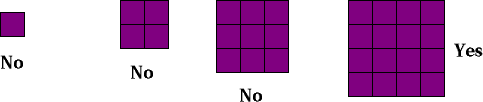
The solutions that arrived on our desk for Numerically Equal all had the same answer, but slightly different ways of finding it. Jack Fawthrop of Tattingstone Primary School sketched the stages of his thinking.
Chris Royston used addition to help him with the perimeter
calculation:
4cm+4cm+4cm+4cm = 16cm.
Whereas, Sam Massey of St Margaret's Primary School in Newcastle-under-Lym, changed this to multiplication: 4cm X 4 (sides) = 16cm
Does this measurement of 4cm work for the area? According to Annice Fishburn and Grace Francis of Year 5 in Yarm Primary School, and Thomas Smith it does! Backing them up with their answers were Jade and Marion Sanders both of Tattingstone Primary. Great explanations came from both girls.
Asher, from Class 9W, had the same idea as a Franco Necchi-Ghiri of Hazelwood School, London N13 and a pupil of Caroline Scott's. Franco solved this "within a few minutes by thinking of square numbers and dividing them by 4." He hit upon a 4cm square as one possible answer but remains convinced it is not the only one has gone to do further investigations on his own! Good for you Franco, let us know of any other solutions your investigations reveal.
There was a second challenge here, finding a rectangle that is twice as long as it is wide and that has an area and perimeter of 18 units. Daniel Vinnicombe, Marion Sanders and Jade (all of Tattingstone School) had the same strategy that worked very well for each of them. Each drew a rectangle then drew the same size rectangle attached to it and calculated the area. Jack Fawthrop shows us a similar way to Marion and Jade's and how he can prove his answer.
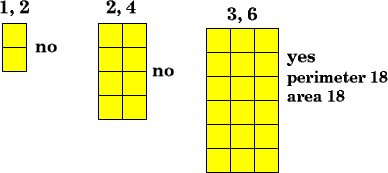
Christopher V. and James Hennwood, both explained in words and numbers rather than diagrams: "The perimeter will be 6+3+6+3 which equals 18cm.
The area is 6 X 3 which equals 18 cm 2."