Hannah tackled the first part of this
problem. Here are the squares she drew:
(a)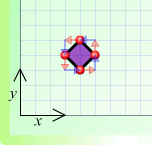 (b)
(b)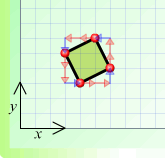 (c)
(c)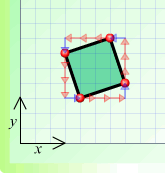
(d)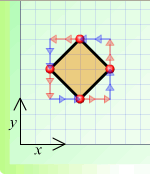 (e)
(e)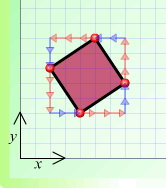
In all of these, the side AB could either
be from the bottom corner to the right, or from the left corner
to the top. Do you see why?
Hannah went on to complete the arrow
notation for these squares. She's taken the side AB to be from
the bottom up to the right.
(a) $A 1 \rightarrow +1 \uparrow B 1 \leftarrow + 1 \uparrow C 1
\leftarrow + 1 \downarrow D 1 \rightarrow + 1 \downarrow A$
(b) $A 2 \rightarrow + 1 \uparrow B 1 \leftarrow + 2 \uparrow C 2
\leftarrow + 1 \downarrow D 1 \rightarrow + 2 \downarrow A$
(c) $A 3 \rightarrow + 1 \uparrow B 1 \leftarrow + 3 \uparrow C 3
\leftarrow + 1 \downarrow D 1 \rightarrow + 3 \downarrow A$
(d) $A 2 \rightarrow + 2 \uparrow B 2 \leftarrow + 2 \uparrow C 2
\leftarrow + 2 \downarrow D 2 \rightarrow + 2 \downarrow A$
(e) $A 3 \rightarrow + 2 \uparrow B 2 \leftarrow + 3 \uparrow C 3
\leftarrow + 2 \downarrow D 2 \rightarrow + 3 \downarrow A$
Good work, Hannah!
Ahmed gave us instructions to construct a square where you are
given one of its sides:
Suppose you're given the side $A a \rightarrow + b \uparrow B$.
(I noticed that $\downarrow$ could be written as $-\uparrow$ and
$\leftarrow$ could be written as $-\rightarrow$, so $a$ and $b$
could be negative, but that doesn't matter. This makes it a bit
easier, as we only have two sorts of arrow then.) Then the square
is either $$A a \rightarrow + b \uparrow B -b \rightarrow +a
\uparrow C -a \rightarrow -b \uparrow D b \rightarrow -a \uparrow
A$$ or $$A a \rightarrow + b \uparrow B b \rightarrow -a \uparrow
C -a \rightarrow - b \uparrow D -b \rightarrow + a \uparrow
A.$$
Well done, Ahmed, especially for spotting that there are two
possible squares.
Ahmed then worked out which of the collections of points could
be a square.
- (8,3), (7,8), (2,7), (3,2). In arrow notation, this would be A -1 ® +5 B -5 ® - 1 C 1 ® - 5 D 5 ® + 1 A. This is of the first form, with a=-1 and b=5. So this is a square.
- (3,3), (7,4), (8,8), (4,7). In arrow notation, this would be A 4 ® + 1 B 1 ® + 4 C -4 ® - 1 D -1 ® - 4 D. This isn't of either form, so the points don't form a square.
- (16,19), (18,22), (21,20), (19,17). In arrow notation, this would be A 2 ® + 3 B 3 ® - 2 C -2 ® - 3 D -3 ® + 2 A. This is of the second form, with a=2 and b=3, so the points form a square.
- (4,20), (21,19), (20,2), (3,3). In arrow notation, this would be A 17 ® - 1 B -1 ® - 17 C -17 ® + 1 D 1 ® + 17 A. This is also of the second form, with a=17 and b=-1, so the points form a square.