Steffi, Emma and Amelia from Girton Glebe Primary School near
Cambridge. We think we have the answer:
We think that the answer is 8 lemons, which have a mass of 60g,
and 4 oranges.
What strategy did the girls use to arrive at that answer? They
explain:
We got the answer by trial and improvement.
We found out that the answer had to be less than 86g by working out
that 2/3 of an orange's mass equals 130g.
The number of lemons had to be even so that there were a whole
number of oranges and not a fraction.
That last point is very important! All the people who wrote in agree with the girls.
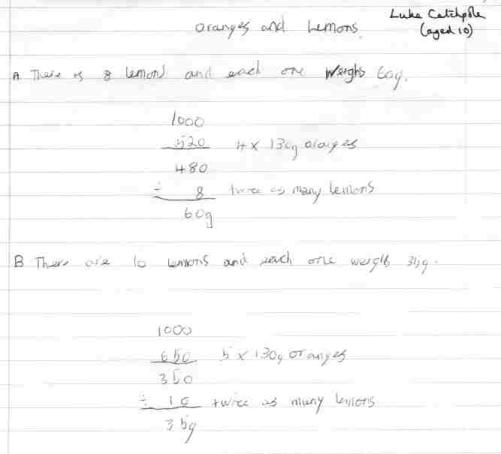
Ahhhh, but Luke shows his calculations to prove to us that there could be more than one possible answer. Do you agree with Luke?
The Year 5 and 6 pupils at Alice Smith International School, in Kuala Lumpur, Malaysia also worked on the Oranges and Lemons problem. They agree with Luke. One of the pupils, Kevin, shows all of the possibilities. They prove that there are in fact two possibilities but that there are no more.
What they already know:
Weights = 1 orange weighs 130g. 1 lemon weighs less than
87g.
Total weight of all oranges and lemons is 1kg. (1000g)
To make it easy to read the answers, the pupils use a table:
| Number of oranges | Number of lemons | Right / Wrong |
|---|---|---|
| 1 | 2 | Wrong |
| 2 | 4 | Wrong |
| 3 | 6 | Wrong |
| 4 | 8 | Right |
| 5 | 10 | Right |
| 6 | 12 | Wrong |
| 7 | 14 | Wrong |
| 8 | 16 | Wrong |
To show how they arrived at each of these answers, here are the calculations: