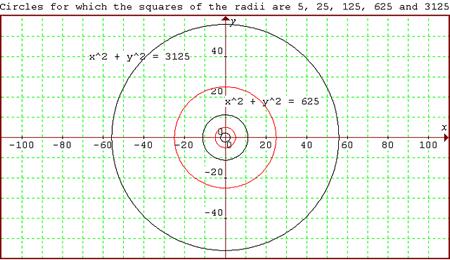
All powers of 5 can be written as the sum of two square numbers in different ways. Investigate the number of points with integer coordinates on circles with centres at the origin for which the square of the radius is a power of 5. For the two circles shown in red in the diagram the radius is a power of 5 and for the circles shown in black this is not so but the square of the radius is a power of 5.
Thanks to Rusi Kolev for the following solution.
To find all the points which lie on the circle k(0;r) and O(0;0) we have to use the circle equation
x2 + y2 = r2 .It is given that
r2 = 5n , n is a positive integer and n ³ 1 ® r = Ö(5n); Then we have the equation x2 + y2 = 5n ® x2 = 5n - y2 ® x = Ö(5n -y2) and x and y are positive integers (belong to N).As
x2 and y2 are positive numbers then x and y are positive or negative. Then we can find all the positive x and y and make up combinations. For example if x1 ³ 0 and y1 ³ 0 then all the solutions are:Here are all the positive solutions for n up to 12:
n |
x |
y |
|
0
|
1
|
0
|
|
0
|
0
|
1
|
|
1
|
2
|
1
|
|
1
|
1
|
2
|
|
2
|
5
|
0
|
|
2
|
4
|
3
|
|
2
|
3
|
4
|
|
2
|
0
|
5
|
|
3
|
11
|
2
|
|
3
|
10
|
5
|
|
3
|
5
|
10
|
|
3
|
2
|
11
|
|
4
|
25
|
0
|
|
4
|
24
|
7
|
|
4
|
20
|
15
|
|
4
|
15
|
20
|
|
4
|
7
|
24
|
|
4
|
0
|
25
|
|
5
|
55
|
10
|
|
5
|
50
|
25
|
|
5
|
41
|
38
|
|
5
|
38
|
41
|
|
5
|
25
|
50
|
|
5
|
10
|
55
|
|
6
|
125
|
0
|
|
6
|
120
|
35
|
|
6
|
117
|
44
|
|
6
|
100
|
75
|
|
6
|
75
|
100
|
|
6
|
44
|
117
|
|
6
|
35
|
120
|
|
6
|
0
|
125
|
|
7
|
278
|
29
|
|
7
|
275
|
50
|
|
7
|
250
|
125
|
|
7
|
205
|
190
|
|
7
|
190
|
205
|
|
7
|
125
|
250
|
|
7
|
50
|
275
|
|
7
|
29
|
278
|
|
8
|
625
|
0
|
|
8
|
600
|
175
|
|
8
|
585
|
220
|
|
8
|
527
|
336
|
|
8
|
500
|
375
|
|
8
|
375
|
500
|
|
8
|
336
|
527
|
|
8
|
220
|
585
|
|
8
|
175
|
600
|
|
8
|
0
|
625
|
|
9
|
1390
|
145
|
|
9
|
1375
|
250
|
|
9
|
1250
|
625
|
|
9
|
1199
|
718
|
|
9
|
1025
|
950
|
|
9
|
950
|
1025
|
|
9
|
718
|
1199
|
|
9
|
625
|
1250
|
|
9
|
250
|
1375
|
|
9
|
145
|
1390
|
|
10
|
3125
|
0
|
|
10
|
3116
|
237
|
|
10
|
3000
|
875
|
|
10
|
2925
|
1100
|
|
10
|
2635
|
1680
|
|
10
|
2500
|
1875
|
|
10
|
1875
|
2500
|
|
10
|
1680
|
2635
|
|
10
|
1100
|
2925
|
|
10
|
875
|
3000
|
|
10
|
237
|
3116
|
|
10
|
0
|
3125
|
|
11
|
6950
|
725
|
|
11
|
6875
|
1250
|
|
11
|
6469
|
2642
|
|
11
|
6250
|
3125
|
|
11
|
5995
|
3590
|
|
11
|
5125
|
4750
|
|
11
|
4750
|
5125
|
|
11
|
3590
|
5995
|
|
11
|
3125
|
6250
|
|
11
|
2642
|
6469
|
|
11
|
1250
|
6875
|
|
11
|
725
|
6950
|
|
12
|
15625
|
1185
|
|
12
|
15580
|
4375
|
|
12
|
15000
|
5500
|
|
12
|
14625
|
8400
|
|
12
|
13175
|
9375
|
|
12
|
12500
|
10296
|
|
12
|
11753
|
11753
|
|
12
|
10296
|
12500
|
|
12
|
9375
|
13175
|
|
12
|
8400
|
14625
|
|
12
|
5500
|
15000
|
|
12
|
4375
|
15580
|
|
12
|
1185
|
15625
|
What we notice is when n = 0 or 1 we have only one solution (by one
solution I mean one pair of POSITIVE integers that satisfy the
equation.
We can always make all the solutions by using the combinations explained above! .
When n = 2 or 3 we have 2 solutions ... so we know that for a given integer n the number of solutions is:1.
If n is even The number of positive solutions is "n + 2".
If n is odd The number of positive solutions is "n + 1".
But why is this so? Why do the solutions always increase with 1?
Let`s take n = 2k (even):
n=2
We notice the solutions:
0 x 51; 51 and 3 x 50; 4 x 50; and 4 x 50; 3 x 50
and 51; 0 x 51
n=4
0 x 52; 52 and 3 x 51; 4 x 51; and 7 x 50; 24 X 50
and 24 x 50; 7 x 50 and 4 x 51; 3 x 51 and 52; 0 x52
n=6
0 x 53; 53 and 3 x 52; 4 x 52; and 7 x 51; 24 x 51
and 44 x 50; 117 x 50; 117 x 50; 44 x 50 and 24 x 51;
7 x 51 and 4 x 52; 3 x 52 and 53; 0 x 53
Every next even n has all the previous solutions but raised to the
+1 power plus TWO NEW solutions.
Now let`s take n = 2k + 1(odd):
n=3, (k=1).
We notice the solutions:
2 x 50; 11 x 50 and 5 x 50; 10 x 50 and 11 x 50; 2 x50
n=5 (k=2)
2 x 51; 11 x 51 and 5 x 51; 10 x 51 and 38 x 50; 41x 50 and 41 x 50; 38 x 50 and 10 x 51; 5 x 51 and 11x 51; 2 x 51
n=7 (k=3)
2 x 52; 11 x 52 and 5 x 52; 10 x 52 and 38 x 51; 41x 51 and 29 x 50; 278 X 50 and 278 x 50; 29 x 50; and
41 x 51; 38 x 51 and 10 x 52; 5 x 52 and 11 x 52; 2x 52
Every next odd n has all the previous solutions but raised to the +1 power plus TWO NEW solutions.
As n approaches infinity the solutions will become more and more ...
Until now we have only discussed the positive integers. If we are to make all the solutions we will use the example above:if
x1 ³ 0 and y1 ³ 0 then all the solutions are: ( x1, y1), (x1, -y1), (-x1, y1), (-x1, -y1). So if we have one solution we can make four (positive and negative) so we have to multiply by 4. Taking the formulae above:But these formulae are also not correct because if we have root
0 then there isn`t +0 and -0. We have root 0 only when n=2k;
k=1,2,3....
We have 4n + 8 solutions if we count +0 and -0. But becausethere is
no difference between +0 and -0 we deduct 2 solutions for every
zero root,
Solutions are: 4n + 8 - 4= 4n + 4 = 4(n + 1). And that`s the number
of solutions for an odd n.