We particularly like the solution from David Bailey, age 17, Gorseinon College, Swansea. Ling Xiang Ning from Raffles Institution also solved this problem and they both showed that there are infinitely many possible solutions.
If the plate rotates by seven comlpete revolutions of itself, equal to 5 circuits around the tray, it means that on each circuit the plate rotates by 7/5 of a revolution.
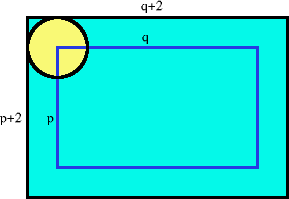
The centre of the circle traces the locus which is continuous and represented as the blue line.
As the points of an arc AB on the circumference of the circle come into contact with the tray, the centre of the circle moves along a path of length AB.
The distance the centre travels during 7 revolutions is 7 times 2 π units.
There are five circuits of the tray so the distance the centre travels per circuit (i.e. perimeter of locus is
| 2p+2q = |
14π
5 |
| p+q = |
7π
5 |
Any values of p and q which satisfy this equation will provide possible solutions.
The dimensions of the tray are p+2 and q+2 and there are many possible values of p and q, for example p = π , q = 2 π /5 or p=q=7 π /10.