Ruoyi Sun, Sarah and Elizabeth from the North London Collegiate
School Puzzle Club sent this neat solution.
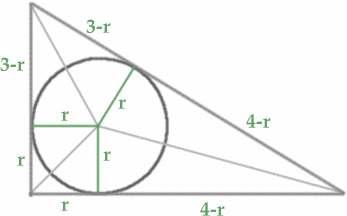
"We found that by drawing the angle bisectors to find the centre
of the incircle, and then drawing in 3 radii, we had created
three pairs of congruent triangles. Therefore we found that part
of the hypotenuse of the 3-4-5 triangle must have length $4-r$
and the other part $3-r$. We formed an equation $$3 - r + 4 -r =
5$$ hence $r = 1.$ For the 5-12-13 triangle the equivalent
formula is $$5 - r + 12 - r = 13$$ and hence $r = 2.$"
Sue Liu of Madras College went further to find a formula for
other Pythagorean triples for right angled triangles with
incircles of radius $k$ for any integer $k$ and this is Sue's
method.
"Clearly the largest circle that fits into a triangle is the
incircle where the circle touches the three sides of the
triangle. For a right angled triangle we can draw radii of length
$r$ from the centre of the incircle perpendicular to each of the
three sides $a$, $b$ and $c$. By equating areas we get $${1\over
2}ar +{1\over 2}br +{1\over 2}cr ={1\over 2}ab.$$ $$r = {ab\over
a + b + c}.$$ For the 3-4-5 triangle $r = 12/(3 + 4 + 5) = 1$ so
the incircle has radius 1. For the 5-12-13 triangle $r = 60/(5 +
12 + 13) = 2$ and the inradius is 2. The next part of the
question asks us to find right angled triangles with incircle
radius 3 and sides which are a primitive Pythagorean triples.
Pythagorean triples ${a, b, c}$ are given parametrically by $$a =
2mn, \ b = m^2 - n^2, \ c = m^2 + n^2$$ where the integers $m$
and $n$ are coprime, one even and the other odd, and $m> n.$
We can consider a triangle with side lengths $2mn, \ m^2 - n^2, \
m^2 + n^2$ Again by equating areas as before, $${1\over 2} (2mnr
+ (m^2 - n^2)r + (m^2 + n^2)r) = {1\over 2}(m^2 - n^2)2mn$$ Hence
$$r = {2mn(m^2 - n^2) \over 2m(m + n)} = n(m -n).$$ By taking
$n=1$ and $m=k + 1$ or alternatively $n = k$ and $m = k + 1$ we
get $r = k$ for any integer $k$ (and of course the triangle has
inradius $k$ even when $k$ is not an integer). For $r = 3$ we
have $n = 1$ and $m = 4$ giving the triangle with sides 8, 15 and
17 or alternatively $n =3$, $m = 4$ in which case $a = 24$, $b =
7$ and $c = 25$. For $r = 4$ we can take $n = 4$, $m = 5$ which
gives the Pythagorean triple $a = 40$, $b = 9$ and $c = 41$."
Sue's generalisation of this problem to isosceles triangles is
given as a Further Inspiration.