Links to the University of Cambridge website
 Links to the NRICH website Home page

Links to the NRICH website Home page
Nurturing young mathematicians: teacher webinars
30 April (Primary), 1 May (Secondary)
30 April (Primary), 1 May (Secondary)
Constellation Sudoku
Age 14 to 18
Challenge Level 

by Henry Kwok
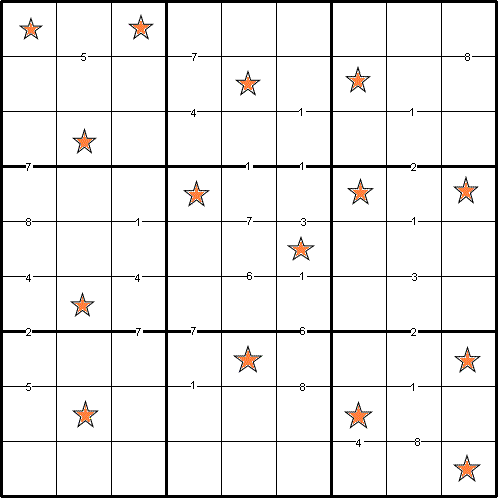
Rules of Constellation Sudoku
Like the standard sudoku, the object of the puzzle is to fill
in the whole 9x9 grid with numbers 1 through 9 so that each row,
each column, and each of the nine 3x3 squares must contain all the
nine different numbers.
There are special clue-numbers placed on the border lines
between selected pairs of adjacent squares of the grid. Each
clue-number is the difference between the two numbers that should
be in the adjacent squares just above and below that clue-number.
For example, a clue-number 7 on the border line means that one of
the possible answers in the square above the clue-number can be 9,
2, 8 or 1. If we choose 9 for the answer in the cell, it means that
the answer in the square below it is 2. If we choose the answer 2,
it means that the answer below it is 9.
The sudoku has two solutions when only clue-numbers are given,
so a set of 15 digits {1, 2, 2, 3, 3, 4, 5, 5, 6, 7, 7, 8, 8, 8, 9}
are also given to reduce those two solutions down to a single
unique solution. The stars represents the positions for each digit
from that set.
Hence, this puzzle is called 'Constellation Sudoku'.
You may also like



Two and Two
How many solutions can you find to this sum? Each of the different letters stands for a different number.