 Links to the NRICH website Home page

30 April (Primary), 1 May (Secondary)
Two and Four Dimensional Numbers


 |
To do this problem you need to know how to add and multiply two by two matrices. This video shows you an example. It might be helpful to know a little bit about Complex Numbers. You might like to read the NRICH article What are Complex Numbers? and explore Complex Numbers with the NRICH feature Adventures with Complex Numbers. |
- Let $C^*$ be the set of $2 \times2$ matrices of the form $$ \left( \begin{array}{cc} x& -y\\ y& x\end{array} \right) $$ where $x$ and $y$ are real numbers.
- Add and multiply the matrices $$\pmatrix {x & -y \cr y & x} {\rm \ and }\ \pmatrix {u & -v \cr v & u}.$$
- Consider also the subset $R^*$ for which $y=0$. Investigate addition and multiplication of matrices from $R^*$ and compare to the arithmetic of real numbers.
- Compare the arithmetic of $C^*$ with that of complex numbers.
- The matrix $\pmatrix {-1 & 0 \cr 0 & -1}$ is equivalent to the real number -1. Find a matrix equivalent to $i = \sqrt {-1}$.
This is asking you to find a matrix ${\bf M}$ which gives ${\bf M}^2=\pmatrix {-1 & 0 \cr 0 & -1}$. Use the general form of matrices in $C^*$ given at the start of this question to help you find ${\bf M}$.
- Complex numbers are two-dimensional numbers $x + iy$ where $x$ and $y$ are real numbers and $i = \sqrt {-1}$. Quaternions are four-dimensional numbers of the form $a+{\bf i}x+{\bf j}y+{\bf k}z$ where $a, x, y, z$ are real numbers and ${\bf i, j, k}$ are all different square roots of $-1$.
One model for the system of quaternions is the set of linear combinations of 2 by 2 matrices: $${\bf I}a +{\bf i}x + {\bf j}y + {\bf k}z\ = \pmatrix {1 & 0\cr 0 & 1}a+ \pmatrix {i & 0\cr 0 & -i}x+\pmatrix {0 & 1\cr -1 & 0}y+ \pmatrix {0 & i\cr i & 0}z$$ where $a, x, y, z$ are real numbers.
- Work out the matrix products: ${\bf i^2, \ j^2}$ and ${\bf k^2}$ showing that these matrices give models of three different square roots of -1.
- Work out the matrix products: ${\bf i j}$, ${\bf j i}$, ${\bf j k}$, ${\bf k j}$, ${\bf k i}$ and ${\bf i k}$.
- Investigate the sequence: ${\bf i},\ $ ${\bf i j},\ $ ${\bf i j}$ ${\bf k},\ $ ${\bf i j}$ ${\bf k i},\ $ ${\bf i j}$ ${\bf k i}$ ${\bf j,\ ...}$
- Work out the matrix products: ${\bf i^2, \ j^2}$ and ${\bf k^2}$ showing that these matrices give models of three different square roots of -1.
There are more matrix problems in this feature.
NOTES AND BACKGROUND
For one dimensional numbers (or the real numbers), each multiplication apart from multiplying by $0$ can be undone by an "inverse" (so the inverse of multiplying by $2$ is multiplying by $\frac 1 2$, or dividing by $2$ as we otherwise know it!)
For two dimensional numbers (complex numbers) we can also find the inverse of a multiplication, i.e. we can divide by a complex number. This works for all complex numbers except for $0+0i$.
Complex numbers can be used to describe points in a plane, so it felt natural to use a three dimensional number to describe points in 3D space. Unfortunately there is no way to undo a three dimensional multiplication - if you think about scalar products and vector products with 3D vectors, there is no way to uniquely undo this.
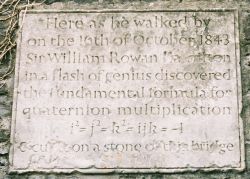
On 16th October 1843 Irish mathematician William Rowan Hamilton suddenly realised that he could find a way of multiplying four dimensional numbers and he carved his formula for doing so into the wall of Broome Bridge, Dublin. The picture at the top of this page shows the plaque on the bridge celebrating this eureka moment.
Amongst other things, Quaternions are used in orbital mechanics and computer graphics and simulations, as they can be used to describe 3D rotations without suffering from "gimbal lock". Here is a video explaining gimbal lock affected Apollo 13 (the "fourth gimbal" discussed as a solution is equivalent to quaternions being used in computer animations.) Instead of an "Euler Rotation", where three numbers are used to describe the angle of rotation in three separate directions, with Quaternion rotation three numbers are used to describe a vector in the direction of the axis of rotation and the last number represents the angle turned about this axis.
This 3Blue1Brown YouTube video introduces quaternions and shows a way of visualising them (this is quite a long video!). You might also be interested in this 3Blue1Brown YouTube video which discusses how complex numbers can be used for 2D rotations and quaternions can be used for 3D rotations.
To find out more explore these Plus articles: Curious Quaternions and Ubiquitous Octonions