 Links to the NRICH website Home page

30 April (Primary), 1 May (Secondary)
Resources tagged with: Iteration
There are 23 NRICH Mathematical resources connected to Iteration, you may find related items under Patterns, sequences and structure.
Broad Topics > Patterns, sequences and structure > Iteration
Climbing Powers
$2\wedge 3\wedge 4$ could be $(2^3)^4$ or $2^{(3^4)}$. Does it make any difference? For both definitions, which is bigger: $r\wedge r\wedge r\wedge r\dots$ where the powers of $r$ go on for ever, or $(r^r)^r$, where $r$ is $\sqrt{2}$?



Rain or Shine
Predict future weather using the probability that tomorrow is wet given today is wet and the probability that tomorrow is wet given that today is dry.

A Very Shiny Nose?
This problem explores the biology behind Rudolph's glowing red nose, and introduces the real life phenomena of bacterial quorum sensing.
Archimedes Numerical Roots
How did Archimedes calculate the lengths of the sides of the polygons which needed him to be able to calculate square roots?
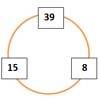
Difference Dynamics Discussion
This article discusses what happens, and why, if you generate chains of sequences getting the next sequence from the differences between the adjacent terms in the sequence before it, eg (7, 2, 8, 3) maps to (5, 6, 5, 4).
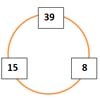
Difference Dynamics
Take three whole numbers. The differences between them give you three new numbers. Find the differences between the new numbers and keep repeating this. What happens?

Ford Circles
Can you find the link between these beautiful circle patterns and Farey Sequences?
Peaches in General
It's like 'Peaches Today, Peaches Tomorrow' but interestingly generalized.

Spirostars
A spiropath is a sequence of connected line segments end to end taking different directions. The same spiropath is iterated. When does it cycle and when does it go on indefinitely?
Stretching Fractions
Imagine a strip with a mark somewhere along it. Fold it in the middle so that the bottom reaches back to the top. Stetch it out to match the original length. Now where's the mark?

The Golden Ratio, Fibonacci Numbers and Continued Fractions.
An iterative method for finding the value of the Golden Ratio with explanations of how this involves the ratios of Fibonacci numbers and continued fractions.

Slippage
A ladder 3m long rests against a wall with one end a short distance from its base. Between the wall and the base of a ladder is a garden storage box 1m tall and 1m high. What is the maximum distance up the wall which the ladder can reach?

V-P Cycles
Form a sequence of vectors by multiplying each vector (using vector products) by a constant vector to get the next one in the seuence(like a GP). What happens?

Dalmatians
Investigate the sequences obtained by starting with any positive 2 digit number (10a+b) and repeatedly using the rule 10a+b maps to 10b-a to get the next number in the sequence.
Stringing it Out
Explore the transformations and comment on what you find.

First Forward Into Logo 10: Count up - Count Down
What happens when a procedure calls itself?

First Forward Into Logo 1: Square Five
A Short introduction to using Logo. This is the first in a twelve part series.

Infinite Continued Fractions
In this article we are going to look at infinite continued fractions - continued fractions that do not terminate.
Converging Means
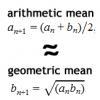
Take any two positive numbers. Calculate the arithmetic and geometric means. Repeat the calculations to generate a sequence of arithmetic means and geometric means. Make a note of what happens to the two sequences.

Differs
Choose any 4 whole numbers and take the difference between consecutive numbers, ending with the difference between the first and the last numbers. What happens when you repeat this process over and over again?
Loopy
Investigate sequences given by $a_n = \frac{1+a_{n-1}}{a_{n-2}}$ for different choices of the first two terms. Make a conjecture about the behaviour of these sequences. Can you prove your conjecture?
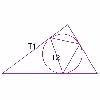
Triangle Incircle Iteration
Keep constructing triangles in the incircle of the previous triangle. What happens?
Route to Root
A sequence of numbers x1, x2, x3, ... starts with x1 = 2, and, if you know any term xn, you can find the next term xn+1 using the formula: xn+1 = (xn + 3/xn)/2 . Calculate the first six terms of this sequence. What do you notice? Calculate a few more terms and find the squares of the terms. Can you prove that the special property you notice about this sequence will apply to all the later terms of the sequence? Write down a formula to give an approximation to the cube root of a number and test it for the cube root of 3 and the cube root of 8. How many terms of the sequence do you have to take before you get the cube root of 8 correct to as many decimal places as your calculator will give? What happens when you try this method for fourth roots or fifth roots etc.?