 Links to the NRICH website Home page

30 April (Primary), 1 May (Secondary)
Resources tagged with: Angles - points, lines and parallel lines
There are 70 NRICH Mathematical resources connected to Angles - points, lines and parallel lines, you may find related items under Angles, polygons, and geometrical proof.
Broad Topics > Angles, polygons, and geometrical proof > Angles - points, lines and parallel lines
Angles Inside
Draw some angles inside a rectangle. What do you notice? Can you prove it?



Polygon Pictures
Can you work out how these polygon pictures were drawn, and use that to figure out their angles?

Triangle in a Trapezium
Can you find and prove the relationship between the area of a trapezium and the area of a triangle constructed within it?
Isosceles Seven
Is it possible to find the angles in this rather special isosceles triangle?
Polygon Rings
Join pentagons together edge to edge. Will they form a ring?

Same Length
Construct two equilateral triangles on a straight line. There are two lengths that look the same - can you prove it?

Olympic Turns
This task looks at the different turns involved in different Olympic sports as a way of exploring the mathematics of turns and angles.

National Flags
This problem explores the shapes and symmetries in some national flags.
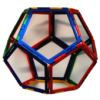
Which Solids Can We Make?
Interior angles can help us to work out which polygons will tessellate. Can we use similar ideas to predict which polygons combine to create semi-regular solids?
What Shape?
This task develops spatial reasoning skills. By framing and asking questions a member of the team has to find out what mathematical object they have chosen.
The Numbers Give the Design
Make new patterns from simple turning instructions. You can have a go using pencil and paper or with a floor robot.
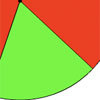
Turning
Use your mouse to move the red and green parts of this disc. Can you make images which show the turnings described?
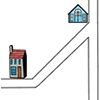
Six Places to Visit
Can you describe the journey to each of the six places on these maps? How would you turn at each junction?

How Safe Are You?
How much do you have to turn these dials by in order to unlock the safes?
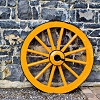
Round and Round and Round
Where will the point stop after it has turned through 30 000 degrees? I took out my calculator and typed 30 000 ÷ 360. How did this help?

Semi-regular Tessellations
Semi-regular tessellations combine two or more different regular polygons to fill the plane. Can you find all the semi-regular tessellations?

Right Angles
Can you make a right-angled triangle on this peg-board by joining up three points round the edge?

Subtended Angles
What is the relationship between the angle at the centre and the angles at the circumference, for angles which stand on the same arc? Can you prove it?
Triangles in Circles
Can you find triangles on a 9-point circle? Can you work out their angles?
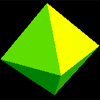
Octa-flower
Join some regular octahedra, face touching face and one vertex of each meeting at a point. How many octahedra can you fit around this point?


Watch the Clock
During the third hour after midnight the hands on a clock point in the same direction (so one hand is over the top of the other). At what time, to the nearest second, does this happen?
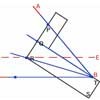
Angle Trisection
It is impossible to trisect an angle using only ruler and compasses but it can be done using a carpenter's square.
Quad in Quad
Join the midpoints of a quadrilateral to get a new quadrilateral. What is special about it?
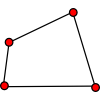
Flexi Quads
A quadrilateral changes shape with the edge lengths constant. Show the scalar product of the diagonals is constant. If the diagonals are perpendicular in one position are they always perpendicular?
Virtual Geoboard
A virtual geoboard that allows you to create shapes by stretching rubber bands between pegs on the board. Allows a variable number of pegs and variable grid geometry and includes a point labeller.
Pegboard Quads
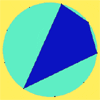
Make different quadrilaterals on a nine-point pegboard, and work out their angles. What do you notice?

Angle Measurement: an Opportunity for Equity
Suggestions for worthwhile mathematical activity on the subject of angle measurement for all pupils.

Watch Those Wheels
Have you ever noticed the patterns in car wheel trims? These questions will make you look at car wheels in a different way!
Sweeping Hands
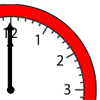
Use your knowledge of angles to work out how many degrees the hour and minute hands of a clock travel through in different amounts of time.
Right Angle Challenge
How many right angles can you make using two sticks?
Pythagoras
Pythagoras of Samos was a Greek philosopher who lived from about 580 BC to about 500 BC. Find out about the important developments he made in mathematics, astronomy, and the theory of music.

Coordinates and Descartes
Have you ever wondered how maps are made? Or perhaps who first thought of the idea of designing maps? We're here to answer these questions for you.
Maurits Cornelius Escher
Have you ever noticed how mathematical ideas are often used in patterns that we see all around us? This article describes the life of Escher who was a passionate believer that maths and art can be intertwined.

Flower
Six circles around a central circle make a flower. Watch the flower as you change the radii in this circle packing. Prove that with the given ratios of the radii the petals touch and fit perfectly.
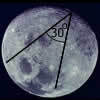
Lunar Angles
What is the sum of the angles of a triangle whose sides are circular arcs on a flat surface? What if the triangle is on the surface of a sphere?
LOGO Challenge 7 - More Stars and Squares
Can you use LOGO to create a systematic reproduction of a basic design? An introduction to variables in a familiar setting.
LOGO Challenge 8 - Rhombi
Explore patterns based on a rhombus. How can you enlarge the pattern - or explode it?
LOGO Challenge 1 - Star Square
Can you use LOGO to create this star pattern made from squares. Only basic LOGO knowledge needed.
Take the Right Angle
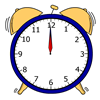
How many times in twelve hours do the hands of a clock form a right angle? Use the interactivity to check your answers.

Parallel Universe
An equilateral triangle is constructed on BC. A line QD is drawn, where Q is the midpoint of AC. Prove that AB // QD.
Similarly So
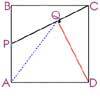
ABCD is a square. P is the midpoint of AB and is joined to C. A line from D perpendicular to PC meets the line at the point Q. Prove AQ = AD.

Hand Swap
My train left London between 6 a.m. and 7 a.m. and arrived in Paris between 9 a.m. and 10 a.m. At the start and end of the journey the hands on my watch were in exactly the same positions but the minute hand and hour hand had swopped places. What time did the train leave London and how long did the journey take?
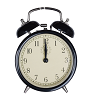
On Time
On a clock the three hands - the second, minute and hour hands - are on the same axis. How often in a 24 hour day will the second hand be parallel to either of the two other hands?
Arrowhead
The points P, Q, R and S are the midpoints of the edges of a non-convex quadrilateral.What do you notice about the quadrilateral PQRS and its area?
A Problem of Time
Consider a watch face which has identical hands and identical marks for the hours. It is opposite to a mirror. When is the time as read direct and in the mirror exactly the same between 6 and 7?
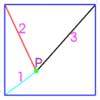
Square World
P is a point inside a square ABCD such that PA= 1, PB = 2 and PC = 3. How big is angle APB ?

Clock Hands
This investigation explores using different shapes as the hands of the clock. What things occur as the the hands move.