 Links to the NRICH website Home page

30 April (Primary), 1 May (Secondary)
Resources tagged with: Regular polygons and circles
There are 106 NRICH Mathematical resources connected to Regular polygons and circles, you may find related items under Angles, polygons, and geometrical proof.
Broad Topics > Angles, polygons, and geometrical proof > Regular polygons and circles
Always, Sometimes or Never? Shape
Are these statements always true, sometimes true or never true?



Olympic Rings
This problem is intended to get children to look really hard at something they will see many times in the next few months.
Shaping It
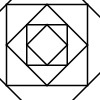
These pictures were made by starting with a square, finding the half-way point on each side and joining those points up. You could investigate your own starting shape.
Curvy Areas
Have a go at creating these images based on circles. What do you notice about the areas of the different sections?
Partly Circles
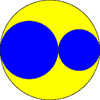
What is the same and what is different about these circle questions? What connections can you make?
Overlapping Again
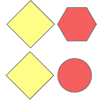
What shape is the overlap when you slide one of these shapes half way across another? Can you picture it in your head? Use the interactivity to check your visualisation.
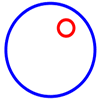
2 Rings
The red ring is inside the blue ring in this picture. Can you rearrange the rings in different ways? Perhaps you can overlap them or put one outside another?
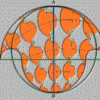
Salinon
This shape comprises four semi-circles. What is the relationship between the area of the shaded region and the area of the circle on AB as diameter?
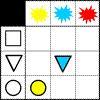
What Shape and Colour?
Can you fill in the empty boxes in the grid with the right shape and colour?

Rolling Around
A circle rolls around the outside edge of a square so that its circumference always touches the edge of the square. Can you describe the locus of the centre of the circle?
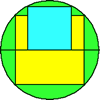
Semi-detached
A square of area 40 square cms is inscribed in a semicircle. Find the area of the square that could be inscribed in a circle of the same radius.
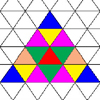
Where Are They?
Use the isometric grid paper to find the different polygons.
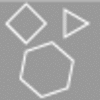
Shapes on the Playground
Sally and Ben were drawing shapes in chalk on the school playground. Can you work out what shapes each of them drew using the clues?
Egyptian Rope
The ancient Egyptians were said to make right-angled triangles using a rope with twelve equal sections divided by knots. What other triangles could you make if you had a rope like this?
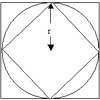
Approximating Pi
By inscribing a circle in a square and then a square in a circle find an approximation to pi. By using a hexagon, can you improve on the approximation?

Hex
Explain how the thirteen pieces making up the regular hexagon shown in the diagram can be re-assembled to form three smaller regular hexagons congruent to each other.
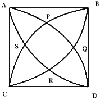
Quadarc
Given a square ABCD of sides 10 cm, and using the corners as centres, construct four quadrants with radius 10 cm each inside the square. The four arcs intersect at P, Q, R and S. Find the area enclosed by PQRS.
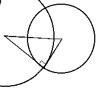
Orthogonal Circle
Given any three non intersecting circles in the plane find another circle or straight line which cuts all three circles orthogonally.
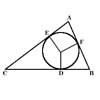
So Big
One side of a triangle is divided into segments of length a and b by the inscribed circle, with radius r. Prove that the area is: abr(a+b)/ab-r^2
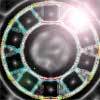
Logosquares
Ten squares form regular rings either with adjacent or opposite vertices touching. Calculate the inner and outer radii of the rings that surround the squares.
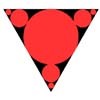
Circles Ad Infinitum
A circle is inscribed in an equilateral triangle. Smaller circles touch it and the sides of the triangle, the process continuing indefinitely. What is the sum of the areas of all the circles?
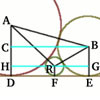
Baby Circle
A small circle fits between two touching circles so that all three circles touch each other and have a common tangent? What is the exact radius of the smallest circle?
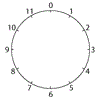
Round and Round the Circle
What happens if you join every second point on this circle? How about every third point? Try with different steps and see if you can predict what will happen.

Sweets in a Box
How many different shaped boxes can you design for 36 sweets in one layer? Can you arrange the sweets so that no sweets of the same colour are next to each other in any direction?
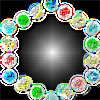
Bracelets
Investigate the different shaped bracelets you could make from 18 different spherical beads. How do they compare if you use 24 beads?
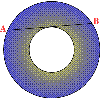
A Chordingly
Find the area of the annulus in terms of the length of the chord which is tangent to the inner circle.
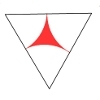
Floored
A floor is covered by a tessellation of equilateral triangles, each having three equal arcs inside it. What proportion of the area of the tessellation is shaded?
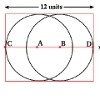
Not So Little X
Two circles are enclosed by a rectangle 12 units by x units. The distance between the centres of the two circles is x/3 units. How big is x?

Coins on a Plate
Points A, B and C are the centres of three circles, each one of which touches the other two. Prove that the perimeter of the triangle ABC is equal to the diameter of the largest circle.
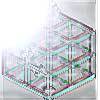
Cube Paths
Given a 2 by 2 by 2 skeletal cube with one route `down' the cube. How many routes are there from A to B?
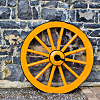
Circle Packing
Equal circles can be arranged so that each circle touches four or six others. What percentage of the plane is covered by circles in each packing pattern? ...
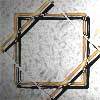
Star Gazing
Find the ratio of the outer shaded area to the inner area for a six pointed star and an eight pointed star.
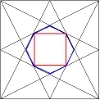
From All Corners
Straight lines are drawn from each corner of a square to the mid points of the opposite sides. Express the area of the octagon that is formed at the centre as a fraction of the area of the square.
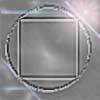
Square Pegs
Which is a better fit, a square peg in a round hole or a round peg in a square hole?
Hexagon Transformations
Can you cut a regular hexagon into two pieces to make a parallelogram? Try cutting it into three pieces to make a rhombus!
Escriptions
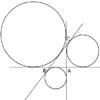
For any right-angled triangle find the radii of the three escribed circles touching the sides of the triangle externally.
Retracircles
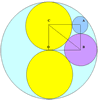
Four circles all touch each other and a circumscribing circle. Find the ratios of the radii and prove that joining 3 centres gives a 3-4-5 triangle.
Get Cross
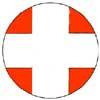
A white cross is placed symmetrically in a red disc with the central square of side length sqrt 2 and the arms of the cross of length 1 unit. What is the area of the disc still showing?
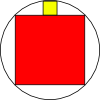
Fitting In
The largest square which fits into a circle is ABCD and EFGH is a square with G and H on the line CD and E and F on the circumference of the circle. Show that AB = 5EF. Similarly the largest equilateral triangle which fits into a circle is LMN and PQR is an equilateral triangle with P and Q on the line LM and R on the circumference of the circle. Show that LM = 3PQ
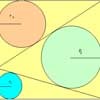
Sangaku
The square ABCD is split into three triangles by the lines BP and CP. Find the radii of the three inscribed circles to these triangles as P moves on AD.
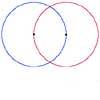
2D-3D
Two circles of equal size intersect and the centre of each circle is on the circumference of the other. What is the area of the intersection? Now imagine that the diagram represents two spheres of equal volume with the centre of each sphere on the surface of the other. What is the volume of intersection?
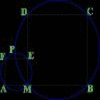
Circumspection
M is any point on the line AB. Squares of side length AM and MB are constructed and their circumcircles intersect at P (and M). Prove that the lines AD and BE produced pass through P.
Area I'n It
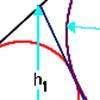
Triangle ABC has altitudes h1, h2 and h3. The radius of the inscribed circle is r, while the radii of the escribed circles are r1, r2 and r3 respectively. Prove: 1/r = 1/h1 + 1/h2 + 1/h3 = 1/r1 + 1/r2 + 1/r3 .
Polycircles
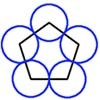
Show that for any triangle it is always possible to construct 3 touching circles with centres at the vertices. Is it possible to construct touching circles centred at the vertices of any polygon?
Ball Bearings
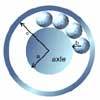
If a is the radius of the axle, b the radius of each ball-bearing, and c the radius of the hub, why does the number of ball bearings n determine the ratio c/a? Find a formula for c/a in terms of n.

Just Touching
Three semi-circles have a common diameter, each touches the other two and two lie inside the biggest one. What is the radius of the circle that touches all three semi-circles?
Kissing
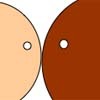
Two perpendicular lines are tangential to two identical circles that touch. What is the largest circle that can be placed in between the two lines and the two circles and how would you construct it?
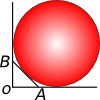
Some(?) of the Parts
A circle touches the lines OA, OB and AB where OA and OB are perpendicular. Show that the diameter of the circle is equal to the perimeter of the triangle
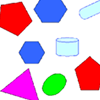
Part the Polygons
Draw three straight lines to separate these shapes into four groups - each group must contain one of each shape.

Clock Hands
This investigation explores using different shapes as the hands of the clock. What things occur as the the hands move.