 Links to the NRICH website Home page

30 April (Primary), 1 May (Secondary)
Resources tagged with: Similarity and congruence
There are 59 NRICH Mathematical resources connected to Similarity and congruence, you may find related items under Angles, polygons, and geometrical proof.
Broad Topics > Angles, polygons, and geometrical proof > Similarity and congruence
The Square Under the Hypotenuse
Can you work out the side length of a square that just touches the hypotenuse of a right angled triangle?



Triangle in a Trapezium
Can you find and prove the relationship between the area of a trapezium and the area of a triangle constructed within it?

Same Length
Construct two equilateral triangles on a straight line. There are two lengths that look the same - can you prove it?

Kite in a Square
Can you make sense of the three methods to work out what fraction of the total area is shaded?

Fit for Photocopying
Explore the relationships between different paper sizes.

Pythagoras Proofs
Can you make sense of these three proofs of Pythagoras' Theorem?
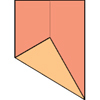
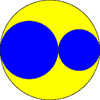
Partly Circles
What is the same and what is different about these circle questions? What connections can you make?

Matching Triangles
Can you sort these triangles into three different families and explain how you did it?
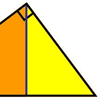
Nicely Similar
If the hypotenuse (base) length is 100cm and if an extra line splits the base into 36cm and 64cm parts, what were the side lengths for the original right-angled triangle?
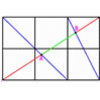
All about Ratios
A new problem posed by Lyndon Baker who has devised many NRICH problems over the years.

Trapezium Four
The diagonals of a trapezium divide it into four parts. Can you create a trapezium where three of those parts are equal in area?

Triangle in a Triangle
Can you work out the fraction of the original triangle that is covered by the inner triangle?
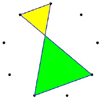
Figure of Eight
On a nine-point pegboard a band is stretched over 4 pegs in a "figure of 8" arrangement. How many different "figure of 8" arrangements can be made ?
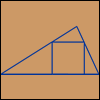
Squirty
Using a ruler, pencil and compasses only, it is possible to construct a square inside any triangle so that all four vertices touch the sides of the triangle.

Hex
Explain how the thirteen pieces making up the regular hexagon shown in the diagram can be re-assembled to form three smaller regular hexagons congruent to each other.
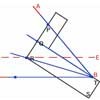
Angle Trisection
It is impossible to trisect an angle using only ruler and compasses but it can be done using a carpenter's square.
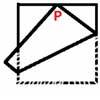
Napkin
A napkin is folded so that a corner coincides with the midpoint of an opposite edge . Investigate the three triangles formed .

Sitting Pretty
A circle of radius r touches two sides of a right angled triangle, sides x and y, and has its centre on the hypotenuse. Can you prove the formula linking x, y and r?
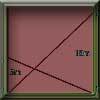
Two Ladders
Two ladders are propped up against facing walls. The end of the first ladder is 10 metres above the foot of the first wall. The end of the second ladder is 5 metres above the foot of the second wall. At what height do the ladders cross?
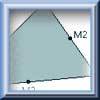
Triangle Midpoints
You are only given the three midpoints of the sides of a triangle. How can you construct the original triangle?

Points in Pairs
Move the point P to see how P' moves. Then use your insights to calculate a missing length.
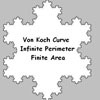
Von Koch Curve
Make a poster using equilateral triangles with sides 27, 9, 3 and 1 units assembled as stage 3 of the Von Koch fractal. Investigate areas & lengths when you repeat a process infinitely often.
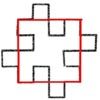
Squareflake
A finite area inside and infinite skin! You can paint the interior of this fractal with a small tin of paint but you could never get enough paint to paint the edge.
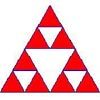
Sierpinski Triangle
What is the total area of the triangles remaining in the nth stage of constructing a Sierpinski Triangle? Work out the dimension of this fractal.
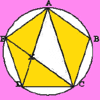
Pentabuild
Explain how to construct a regular pentagon accurately using a straight edge and compass.

Slippage
A ladder 3m long rests against a wall with one end a short distance from its base. Between the wall and the base of a ladder is a garden storage box 1m tall and 1m high. What is the maximum distance up the wall which the ladder can reach?
Bus Stop
Two buses leave at the same time from two towns Shipton and Veston on the same long road, travelling towards each other. At each mile along the road are milestones. The buses' speeds are constant and in the ratio 5 to 4. The buses travel to and fro between the towns. What milestones are at Shipton and Veston?
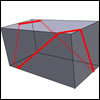
All Tied Up
A ribbon runs around a box so that it makes a complete loop with two parallel pieces of ribbon on the top. How long will the ribbon be?

Flower
Six circles around a central circle make a flower. Watch the flower as you change the radii in this circle packing. Prove that with the given ratios of the radii the petals touch and fit perfectly.
Arrh!
Triangle ABC is equilateral. D, the midpoint of BC, is the centre of the semi-circle whose radius is R which touches AB and AC, as well as a smaller circle with radius r which also touches AB and AC. What is the value of r/R?
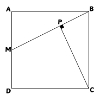
Two Triangles in a Square
Given that ABCD is a square, M is the mid point of AD and CP is perpendicular to MB with P on MB, prove DP = DC.
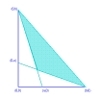
A Shade Crossed
Find the area of the shaded region created by the two overlapping triangles in terms of a and b?

Pentakite
Given a regular pentagon, can you find the distance between two non-adjacent vertices?

Chord
Equal touching circles have centres on a line. From a point of this line on a circle, a tangent is drawn to the farthest circle. Find the lengths of chords where the line cuts the other circles.

Overlap
A red square and a blue square overlap. Is the area of the overlap always the same?
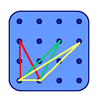
Triangular Tantaliser
Draw all the possible distinct triangles on a 4 x 4 dotty grid. Convince me that you have all possible triangles.

Parallel Universe
An equilateral triangle is constructed on BC. A line QD is drawn, where Q is the midpoint of AC. Prove that AB // QD.
Matter of Scale
Can you prove Pythagoras' Theorem using enlargements and scale factors?
Pent
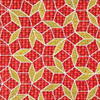
The diagram shows a regular pentagon with sides of unit length. Find all the angles in the diagram. Prove that the quadrilateral shown in red is a rhombus.
Folding Squares
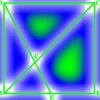
The diagonal of a square intersects the line joining one of the unused corners to the midpoint of the opposite side. What do you notice about the line segments produced?
How Big?
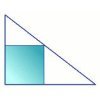
If the sides of the triangle in the diagram are 3, 4 and 5, what is the area of the shaded square?
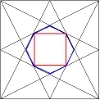
From All Corners
Straight lines are drawn from each corner of a square to the mid points of the opposite sides. Express the area of the octagon that is formed at the centre as a fraction of the area of the square.

A Sameness Surely
Triangle ABC has a right angle at C. ACRS and CBPQ are squares. ST and PU are perpendicular to AB produced. Show that ST + PU = AB
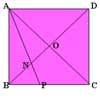
Look Before You Leap
Can you spot a cunning way to work out the missing length?
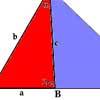
Double Angle Triples
Try out this geometry problem involving trigonometry and number theory
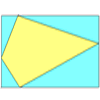
Strange Rectangle
ABCD is a rectangle and P, Q, R and S are moveable points on the edges dividing the edges in certain ratios. Strangely PQRS is always a cyclic quadrilateral and you can find the angles.
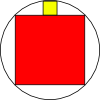
Fitting In
The largest square which fits into a circle is ABCD and EFGH is a square with G and H on the line CD and E and F on the circumference of the circle. Show that AB = 5EF. Similarly the largest equilateral triangle which fits into a circle is LMN and PQR is an equilateral triangle with P and Q on the line LM and R on the circumference of the circle. Show that LM = 3PQ
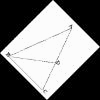
Golden Triangle
Three triangles ABC, CBD and ABD (where D is a point on AC) are all isosceles. Find all the angles. Prove that the ratio of AB to BC is equal to the golden ratio.
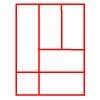
Is a Square a Rectangle?
How many rectangles can you find in this shape? Which ones are differently sized and which are 'similar'?