 Links to the NRICH website Home page

30 April (Primary), 1 May (Secondary)
Resources tagged with: Trigonometric identities
There are 13 NRICH Mathematical resources connected to Trigonometric identities, you may find related items under Pythagoras and trigonometry.
Broad Topics > Pythagoras and trigonometry > Trigonometric identities
T for Tan
Can you find a way to prove the trig identities using a diagram?



Loch Ness
Draw graphs of the sine and modulus functions and explain the humps.
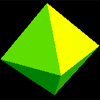
Octa-flower
Join some regular octahedra, face touching face and one vertex of each meeting at a point. How many octahedra can you fit around this point?

Shape and Territory
If for any triangle ABC tan(A - B) + tan(B - C) + tan(C - A) = 0 what can you say about the triangle?
Trig Reps
Can you deduce the familiar properties of the sine and cosine functions starting from these three different mathematical representations?
Round and Round a Circle
Can you explain what is happening and account for the values being displayed?
Quaternions and Reflections
See how 4 dimensional quaternions involve vectors in 3-space and how the quaternion function F(v) = nvn gives a simple algebraic method of working with reflections in planes in 3-space.
Quaternions and Rotations
Find out how the quaternion function G(v) = qvq^-1 gives a simple algebraic method for working with rotations in 3-space.
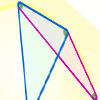
Sine and Cosine for Connected Angles
The length AM can be calculated using trigonometry in two different ways. Create this pair of equivalent calculations for different peg boards, notice a general result, and account for it.
Polar Flower
This polar equation is a quadratic. Plot the graph given by each factor to draw the flower.

What Are Complex Numbers?
This article introduces complex numbers, brings together into one bigger 'picture' some closely related elementary ideas like vectors and the exponential and trigonometric functions and their derivatives and proves that e^(i pi)= -1.
Reflect Again
Follow hints to investigate the matrix which gives a reflection of the plane in the line y=tanx. Show that the combination of two reflections in intersecting lines is a rotation.
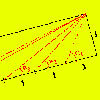
Why Stop at Three by One
Beautiful mathematics. Two 18 year old students gave eight different proofs of one result then generalised it from the 3 by 1 case to the n by 1 case and proved the general result.