 Links to the NRICH website Home page

30 April (Primary), 1 May (Secondary)
Resources tagged with: Vector algebra
There are 7 NRICH Mathematical resources connected to Vector algebra, you may find related items under Vectors and matrices.
Broad Topics > Vectors and matrices > Vector algebra
Vector Journeys
Charlie likes to go for walks around a square park, while Alison likes to cut across diagonally. Can you find relationships between the vectors they walk along?


Tetra Perp
Show that the edges $AD$ and $BC$ of a tetrahedron $ABCD$ are mutually perpendicular if and only if $AB^2 +CD^2 = AC^2+BD^2$. This problem uses the scalar product of two vectors.
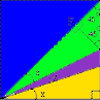
Three by One
There are many different methods to solve this geometrical problem - how many can you find?
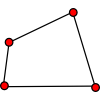
Flexi Quads
A quadrilateral changes shape with the edge lengths constant. Show the scalar product of the diagonals is constant. If the diagonals are perpendicular in one position are they always perpendicular?

Quaternions and Reflections
See how 4 dimensional quaternions involve vectors in 3-space and how the quaternion function F(v) = nvn gives a simple algebraic method of working with reflections in planes in 3-space.
Quaternions and Rotations
Find out how the quaternion function G(v) = qvq^-1 gives a simple algebraic method for working with rotations in 3-space.

Flexi Quad Tan
As a quadrilateral Q is deformed (keeping the edge lengths constnt) the diagonals and the angle X between them change. Prove that the area of Q is proportional to tanX.