 Links to the NRICH website Home page

30 April (Primary), 1 May (Secondary)
Resources tagged with: Vectors
There are 25 NRICH Mathematical resources connected to Vectors, you may find related items under Vectors and matrices.
Broad Topics > Vectors and matrices > Vectors
Vector Gem Collector
Use vectors to collect as many gems as you can and bring them safely home!




Vector Journeys
Charlie likes to go for walks around a square park, while Alison likes to cut across diagonally. Can you find relationships between the vectors they walk along?
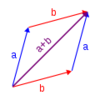
Vector Walk
Starting with two basic vector steps, which destinations can you reach on a vector walk?
Spotting the Loophole
A visualisation problem in which you search for vectors which sum to zero from a jumble of arrows. Will your eyes be quicker than algebra?
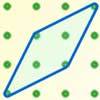
Areas of Parallelograms
Can you find the area of a parallelogram defined by two vectors?
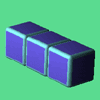
Cubestick
Stick some cubes together to make a cuboid. Find two of the angles by as many different methods as you can devise.

Square Coordinates
A tilted square is a square with no horizontal sides. Can you devise a general instruction for the construction of a square when you are given just one of its sides?
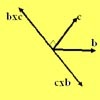
Multiplication of Vectors
An account of multiplication of vectors, both scalar products and vector products.
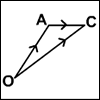
An Introduction to Vectors
The article provides a summary of the elementary ideas about vectors usually met in school mathematics, describes what vectors are and how to add, subtract and multiply them by scalars and indicates why they are useful.
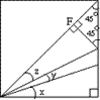
8 Methods for Three by One
This problem in geometry has been solved in no less than EIGHT ways by a pair of students. How would you solve it? How many of their solutions can you follow? How are they the same or different? Which do you like best?
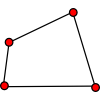
Flexi Quads
A quadrilateral changes shape with the edge lengths constant. Show the scalar product of the diagonals is constant. If the diagonals are perpendicular in one position are they always perpendicular?
Another Triangle in a Triangle
Can you work out the fraction of the original triangle that is covered by the green triangle?
From Point to Point
Can you combine vectors to get from one point to another?

Matrix Meaning
Explore the meaning behind the algebra and geometry of matrices with these 10 individual problems.

Polygon Walk
Go on a vector walk and determine which points on the walk are closest to the origin.

Fix Me or Crush Me
Can you make matrices which will fix one lucky vector and crush another to zero?
Coordinated Crystals
Explore the lattice and vector structure of this crystal.

V-P Cycles
Form a sequence of vectors by multiplying each vector (using vector products) by a constant vector to get the next one in the seuence(like a GP). What happens?
Air Routes
Find the distance of the shortest air route at an altitude of 6000 metres between London and Cape Town given the latitudes and longitudes. A simple application of scalar products of vectors.

Flexi Quad Tan
As a quadrilateral Q is deformed (keeping the edge lengths constnt) the diagonals and the angle X between them change. Prove that the area of Q is proportional to tanX.
The Use of Mathematics in Computer Games
An account of how mathematics is used in computer games including geometry, vectors, transformations, 3D graphics, graph theory and simulations.
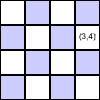
A Knight's Journey
This article looks at knight's moves on a chess board and introduces you to the idea of vectors and vector addition.