 Links to the NRICH website Home page

30 April (Primary), 1 May (Secondary)
Resources tagged with: Translations
There are 25 NRICH Mathematical resources connected to Translations, you may find related items under Transformations and constructions.
Broad Topics > Transformations and constructions > Translations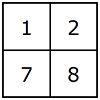
So It's Times!
How will you decide which way of flipping over and/or turning the grid will give you the highest total?

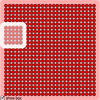
Poly Plug Pattern
Create a pattern on the small grid. How could you extend your pattern on the larger grid?

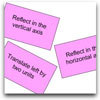
Surprising Transformations
I took the graph y=4x+7 and performed four transformations. Can you find the order in which I could have carried out the transformations?
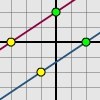
Translating Lines
Investigate what happens to the equation of different lines when you translate them. Try to predict what will happen. Explain your findings.

Who is the fairest of them all ?
Explore the effect of combining enlargements.

Mirror, Mirror...
Explore the effect of reflecting in two parallel mirror lines.
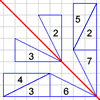
Transformation Game
Why not challenge a friend to play this transformation game?
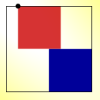
Is There a Theorem?
Draw a square. A second square of the same size slides around the first always maintaining contact and keeping the same orientation. How far does the dot travel?
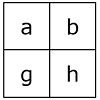
It's Times Again
Which way of flipping over and/or turning this grid will give you the highest total? You'll need to imagine where the numbers will go in this tricky task!
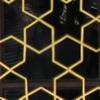
Topkapi Palace
These images are taken from the Topkapi Palace in Istanbul, Turkey. Can you work out the basic unit that makes up each pattern? Can you continue the pattern? Can you see any similarities and differences in the designs?
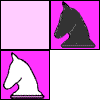
Knights Moving
Can you swap the black knights with the white knights in the minimum number of moves?
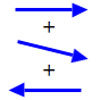
Arrow Arithmetic 1
The first part of an investigation into how to represent numbers using geometric transformations that ultimately leads us to discover numbers not on the number line.
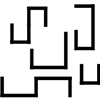
Shape Mapping
What is the relationship between these first two shapes? Which shape relates to the third one in the same way? Can you explain why?
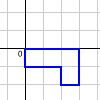
Combining Transformations
Does changing the order of transformations always/sometimes/never produce the same transformation?
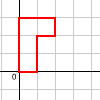
Decoding Transformations
See the effects of some combined transformations on a shape. Can you describe what the individual transformations do?

Symmetric Trace
Points off a rolling wheel make traces. What makes those traces have symmetry?
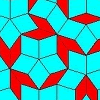
Shaping up with Tessellations
This article describes the scope for practical exploration of tessellations both in and out of the classroom. It seems a golden opportunity to link art with maths, allowing the creative side of your children to take over.
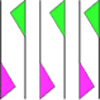
Friezes
Some local pupils lost a geometric opportunity recently as they surveyed the cars in the car park. Did you know that car tyres, and the wheels that they on, are a rich source of geometry?
The Frieze Tree
Patterns that repeat in a line are strangely interesting. How many types are there and how do you tell one type from another?
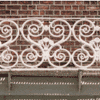
Frieze Patterns in Cast Iron
A gallery of beautiful photos of cast ironwork friezes in Australia with a mathematical discussion of the classification of frieze patterns.
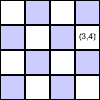
A Knight's Journey
This article looks at knight's moves on a chess board and introduces you to the idea of vectors and vector addition.
Penta Play
A shape and space game for 2, 3 or 4 players. Be the last person to be able to place a pentomino piece on the playing board.
Khun Phaen Escapes to Freedom
Slide the pieces to move Khun Phaen past all the guards into the position on the right from which he can escape to freedom.
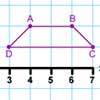
Transformation Tease
What are the coordinates of this shape after it has been transformed in the ways described? Compare these with the original coordinates. What do you notice about the numbers?