 Links to the NRICH website Home page

30 April (Primary), 1 May (Secondary)
Resources tagged with: 2D shapes and their properties
There are 75 results
Broad Topics > Angles, polygons, and geometrical proof > 2D shapes and their properties
Rhombus It
Players take it in turns to choose a dot on the grid. The winner is the first to have four dots that can be joined to form a rhombus.


Parallelogram It
Players take it in turns to choose a dot on the grid. The winner is the first to have four dots that can be joined to form a parallelogram.

An Equilateral Triangular Problem
Take an equilateral triangle and cut it into smaller pieces. What can you do with them?
Completing Quadrilaterals
We started drawing some quadrilaterals - can you complete them?
Guess my Quad
How many questions do you need to identify my quadrilateral?

Hidden Squares
Can you find the squares hidden on these coordinate grids?
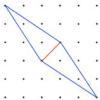
Opposite Vertices
Can you recreate squares and rhombuses if you are only given a side or a diagonal?

Track Design
Where should runners start the 200m race so that they have all run the same distance by the finish?
What Shape?
This task develops spatial reasoning skills. By framing and asking questions a member of the team has to find out what mathematical object they have chosen.

Curvy Areas
Have a go at creating these images based on circles. What do you notice about the areas of the different sections?

Trapezium Four
The diagonals of a trapezium divide it into four parts. Can you create a trapezium where three of those parts are equal in area?
Property Chart
A game in which players take it in turns to try to draw quadrilaterals (or triangles) with particular properties. Is it possible to fill the game grid?
Shapely Pairs
A game in which players take it in turns to turn up two cards. If they can draw a triangle which satisfies both properties they win the pair of cards. And a few challenging questions to follow...
Quadrilaterals Game
A game for 2 or more people, based on the traditional card game Rummy.

Square Coordinates
A tilted square is a square with no horizontal sides. Can you devise a general instruction for the construction of a square when you are given just one of its sides?

Efficient Cutting
Use a single sheet of A4 paper and make a cylinder having the greatest possible volume. The cylinder must be closed off by a circle at each end.
Square It
Players take it in turns to choose a dot on the grid. The winner is the first to have four dots that can be joined to form a square.
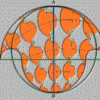
Salinon
This shape comprises four semi-circles. What is the relationship between the area of the shaded region and the area of the circle on AB as diameter?

Rolling Around
A circle rolls around the outside edge of a square so that its circumference always touches the edge of the square. Can you describe the locus of the centre of the circle?
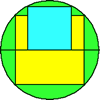
Semi-detached
A square of area 40 square cms is inscribed in a semicircle. Find the area of the square that could be inscribed in a circle of the same radius.
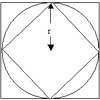
Approximating Pi
By inscribing a circle in a square and then a square in a circle find an approximation to pi. By using a hexagon, can you improve on the approximation?
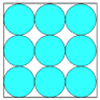
Blue and White
Identical squares of side one unit contain some circles shaded blue. In which of the four examples is the shaded area greatest?

Hex
Explain how the thirteen pieces making up the regular hexagon shown in the diagram can be re-assembled to form three smaller regular hexagons congruent to each other.
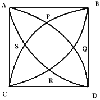
Quadarc
Given a square ABCD of sides 10 cm, and using the corners as centres, construct four quadrants with radius 10 cm each inside the square. The four arcs intersect at P, Q, R and S. Find the area enclosed by PQRS.
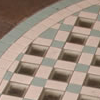
Squaring the Circle
Bluey-green, white and transparent squares with a few odd bits of shapes around the perimeter. But, how many squares are there of each type in the complete circle? Study the picture and make an estimate.
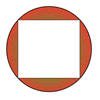
Semi-square
What is the ratio of the area of a square inscribed in a semicircle to the area of the square inscribed in the entire circle?
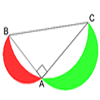
Crescents and Triangles
Can you find a relationship between the area of the crescents and the area of the triangle?
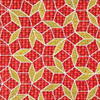
Pent
The diagram shows a regular pentagon with sides of unit length. Find all the angles in the diagram. Prove that the quadrilateral shown in red is a rhombus.
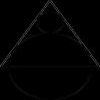
Tricircle
The centre of the larger circle is at the midpoint of one side of an equilateral triangle and the circle touches the other two sides of the triangle. A smaller circle touches the larger circle and two sides of the triangle. If the small circle has radius 1 unit find the radius of the larger circle.
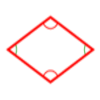
Rhombus in Rectangle
Take any rectangle ABCD such that AB > BC. The point P is on AB and Q is on CD. Show that there is exactly one position of P and Q such that APCQ is a rhombus.
2001 Spatial Oddity
With one cut a piece of card 16 cm by 9 cm can be made into two pieces which can be rearranged to form a square 12 cm by 12 cm. Explain how this can be done.
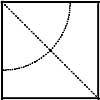
The Medieval Octagon
Medieval stonemasons used a method to construct octagons using ruler and compasses... Is the octagon regular? Proof please.
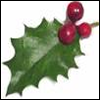
Holly
The ten arcs forming the edges of the "holly leaf" are all arcs of circles of radius 1 cm. Find the length of the perimeter of the holly leaf and the area of its surface.
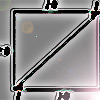
Lying and Cheating
Follow the instructions and you can take a rectangle, cut it into 4 pieces, discard two small triangles, put together the remaining two pieces and end up with a rectangle the same size. Try it!
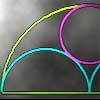
Three Four Five
Two semi-circles (each of radius 1/2) touch each other, and a semi-circle of radius 1 touches both of them. Find the radius of the circle which touches all three semi-circles.
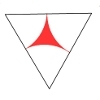
Floored
A floor is covered by a tessellation of equilateral triangles, each having three equal arcs inside it. What proportion of the area of the tessellation is shaded?
Not So Little X
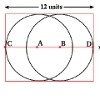
Two circles are enclosed by a rectangle 12 units by x units. The distance between the centres of the two circles is x/3 units. How big is x?
Circle Packing
Equal circles can be arranged so that each circle touches four or six others. What percentage of the plane is covered by circles in each packing pattern? ...
Roaming Rhombus
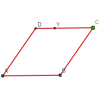
We have four rods of equal lengths hinged at their endpoints to form a rhombus ABCD. Keeping AB fixed we allow CD to take all possible positions in the plane. What is the locus (or path) of the point D?
From All Corners
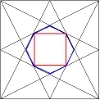
Straight lines are drawn from each corner of a square to the mid points of the opposite sides. Express the area of the octagon that is formed at the centre as a fraction of the area of the square.
Square Pegs
Which is a better fit, a square peg in a round hole or a round peg in a square hole?
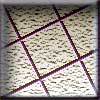
Square Areas
Can you work out the area of the inner square and give an explanation of how you did it?
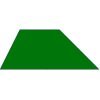
Dividing the Field
A farmer has a field which is the shape of a trapezium as illustrated below. To increase his profits he wishes to grow two different crops. To do this he would like to divide the field into two trapeziums each of equal area. How could he do this?
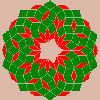
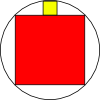
Fitting In
The largest square which fits into a circle is ABCD and EFGH is a square with G and H on the line CD and E and F on the circumference of the circle. Show that AB = 5EF. Similarly the largest equilateral triangle which fits into a circle is LMN and PQR is an equilateral triangle with P and Q on the line LM and R on the circumference of the circle. Show that LM = 3PQ
Lawnmower
A kite shaped lawn consists of an equilateral triangle ABC of side 130 feet and an isosceles triangle BCD in which BD and CD are of length 169 feet. A gardener has a motor mower which cuts strips of grass exactly one foot wide and wishes to cut the entire lawn in parallel strips. What is the minimum number of strips the gardener must mow?
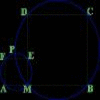
Circumspection
M is any point on the line AB. Squares of side length AM and MB are constructed and their circumcircles intersect at P (and M). Prove that the lines AD and BE produced pass through P.
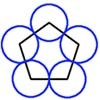
Polycircles
Show that for any triangle it is always possible to construct 3 touching circles with centres at the vertices. Is it possible to construct touching circles centred at the vertices of any polygon?
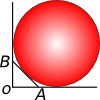
Some(?) of the Parts
A circle touches the lines OA, OB and AB where OA and OB are perpendicular. Show that the diameter of the circle is equal to the perimeter of the triangle