 Links to the NRICH website Home page

30 April (Primary), 1 May (Secondary)
Resources tagged with: Quadrilaterals
There are 29 results
Broad Topics > Angles, polygons, and geometrical proof > Quadrilaterals
Rhombus It
Players take it in turns to choose a dot on the grid. The winner is the first to have four dots that can be joined to form a rhombus.



Parallelogram It
Players take it in turns to choose a dot on the grid. The winner is the first to have four dots that can be joined to form a parallelogram.

An Equilateral Triangular Problem
Take an equilateral triangle and cut it into smaller pieces. What can you do with them?

Completing Quadrilaterals
We started drawing some quadrilaterals - can you complete them?

Guess my Quad
How many questions do you need to identify my quadrilateral?
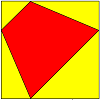
Quadrilaterals in a Square
What's special about the area of quadrilaterals drawn in a square?
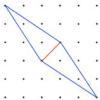
Opposite Vertices
Can you recreate squares and rhombuses if you are only given a side or a diagonal?

Making Rectangles
A task which depends on members of the group noticing the needs of others and responding.
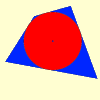
Circles in Quadrilaterals
Explore when it is possible to construct a circle which just touches all four sides of a quadrilateral.

Trapezium Four
The diagonals of a trapezium divide it into four parts. Can you create a trapezium where three of those parts are equal in area?
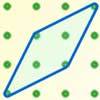
Areas of Parallelograms
Can you find the area of a parallelogram defined by two vectors?

Property Chart
A game in which players take it in turns to try to draw quadrilaterals (or triangles) with particular properties. Is it possible to fill the game grid?
Shapely Pairs
A game in which players take it in turns to turn up two cards. If they can draw a triangle which satisfies both properties they win the pair of cards. And a few challenging questions to follow...

Quadrilaterals Game
A game for 2 or more people, based on the traditional card game Rummy.

Square It
Players take it in turns to choose a dot on the grid. The winner is the first to have four dots that can be joined to form a square.

Quad in Quad
Join the midpoints of a quadrilateral to get a new quadrilateral. What is special about it?

Bendy Quad
Four rods are hinged at their ends to form a convex quadrilateral. Investigate the different shapes that the quadrilateral can take. Be patient this problem may be slow to load.

Quadrilaterals in a Hexagon
Which of these quadrilaterals can you find in the hexagon?

Triangle Transformation
Start with a triangle. Can you cut it up to make a rectangle?

Square Pair
Explore the shape of a square after it is transformed by the action of a matrix.

Bicentric Quadrilaterals
Investigate the properties of quadrilaterals which can be drawn with a circle just touching each side and another circle just touching each vertex.

The Cyclic Quadrilateral
This gives a short summary of the properties and theorems of cyclic quadrilaterals and links to some practical examples to be found elsewhere on the site.

Making Rectangles, Making Squares
How many differently shaped rectangles can you build using these equilateral and isosceles triangles? Can you make a square?
Cyclic Quad Jigsaw
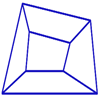
A picture is made by joining five small quadrilaterals together to make a large quadrilateral. Is it possible to draw a similar picture if all the small quadrilaterals are cyclic?

Linkage
Four rods, two of length a and two of length b, are linked to form a kite. The linkage is moveable so that the angles change. What is the maximum area of the kite?

Arrowhead
The points P, Q, R and S are the midpoints of the edges of a non-convex quadrilateral.What do you notice about the quadrilateral PQRS and its area?
Dividing the Field
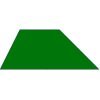
A farmer has a field which is the shape of a trapezium as illustrated below. To increase his profits he wishes to grow two different crops. To do this he would like to divide the field into two trapeziums each of equal area. How could he do this?

Long Short
What can you say about the lengths of the sides of a quadrilateral whose vertices are on a unit circle?
Lawnmower
A kite shaped lawn consists of an equilateral triangle ABC of side 130 feet and an isosceles triangle BCD in which BD and CD are of length 169 feet. A gardener has a motor mower which cuts strips of grass exactly one foot wide and wishes to cut the entire lawn in parallel strips. What is the minimum number of strips the gardener must mow?