 Links to the NRICH website Home page

30 April (Primary), 1 May (Secondary)
Resources tagged with: Angles - points, lines and parallel lines
There are 31 results
Broad Topics > Angles, polygons, and geometrical proof > Angles - points, lines and parallel lines
Olympic Turns
This task looks at the different turns involved in different Olympic sports as a way of exploring the mathematics of turns and angles.

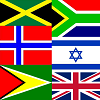
National Flags
This problem explores the shapes and symmetries in some national flags.

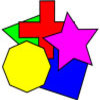
What Shape?
This task develops spatial reasoning skills. By framing and asking questions a member of the team has to find out what mathematical object they have chosen.
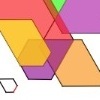
The Numbers Give the Design
Make new patterns from simple turning instructions. You can have a go using pencil and paper or with a floor robot.
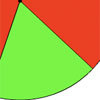
Turning
Use your mouse to move the red and green parts of this disc. Can you make images which show the turnings described?
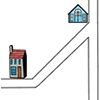
Six Places to Visit
Can you describe the journey to each of the six places on these maps? How would you turn at each junction?

How Safe Are You?
How much do you have to turn these dials by in order to unlock the safes?


Watch the Clock
During the third hour after midnight the hands on a clock point in the same direction (so one hand is over the top of the other). At what time, to the nearest second, does this happen?
Being Resilient - Lower Primary Geometry
Are you resilient enough to solve these geometry problems?

Being Resourceful - Lower Primary Geometry
Geometry problems for lower primary that will get you thinking.
Being Resilient - Primary Geometry
Geometry problems at primary level that may require resilience.

Being Resourceful - Primary Geometry
Geometry problems at primary level that require careful consideration.

Being Collaborative - Primary Geometry
Geometry problems for primary learners to work on with others.

Being Curious - Primary Geometry
Geometry problems for inquiring primary learners.
Cylinder Cutting
An activity for high-attaining learners which involves making a new cylinder from a cardboard tube.
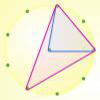
Interacting with the Geometry of the Circle
Jennifer Piggott and Charlie Gilderdale describe a free interactive circular geoboard environment that can lead learners to pose mathematical questions.
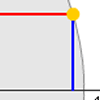
Dotty Circle
Watch this film carefully. Can you find a general rule for explaining when the dot will be this same distance from the horizontal axis?
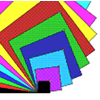
Overlapping Squares
Have a good look at these images. Can you describe what is happening? There are plenty more images like this on NRICH's Exploring Squares CD.

Making Maths: Equilateral Triangle Folding
Make an equilateral triangle by folding paper and use it to make patterns of your own.

Dotty Relationship
Can you draw perpendicular lines without using a protractor? Investigate how this is possible.

Watch Those Wheels
Have you ever noticed the patterns in car wheel trims? These questions will make you look at car wheels in a different way!
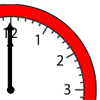
Sweeping Hands
Use your knowledge of angles to work out how many degrees the hour and minute hands of a clock travel through in different amounts of time.
Right Angle Challenge
How many right angles can you make using two sticks?
Pythagoras
Pythagoras of Samos was a Greek philosopher who lived from about 580 BC to about 500 BC. Find out about the important developments he made in mathematics, astronomy, and the theory of music.
Coordinates and Descartes
Have you ever wondered how maps are made? Or perhaps who first thought of the idea of designing maps? We're here to answer these questions for you.
Maurits Cornelius Escher
Have you ever noticed how mathematical ideas are often used in patterns that we see all around us? This article describes the life of Escher who was a passionate believer that maths and art can be intertwined.

LOGO Challenge 8 - Rhombi
Explore patterns based on a rhombus. How can you enlarge the pattern - or explode it?

LOGO Challenge 1 - Star Square
Can you use LOGO to create this star pattern made from squares. Only basic LOGO knowledge needed.
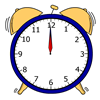
Take the Right Angle
How many times in twelve hours do the hands of a clock form a right angle? Use the interactivity to check your answers.

Clock Hands
This investigation explores using different shapes as the hands of the clock. What things occur as the the hands move.