 Links to the NRICH website Home page

30 April (Primary), 1 May (Secondary)
Resources tagged with: Reasoning, convincing and proving
There are 229 results
Broad Topics > Thinking mathematically > Reasoning, convincing and proving
Elevenses
How many pairs of numbers can you find that add up to a multiple of 11? Do you notice anything interesting about your results?



Iffy Logic
Can you rearrange the cards to make a series of correct mathematical statements?
LCM Sudoku
Here is a Sudoku with a difference! Use information about lowest common multiples to help you solve it.
Consecutive Negative Numbers
Do you notice anything about the solutions when you add and/or subtract consecutive negative numbers?
Difference Sudoku
Use the differences to find the solution to this Sudoku.

Product Sudoku
The clues for this Sudoku are the product of the numbers in adjacent squares.


Multiplication Square
Pick a square within a multiplication square and add the numbers on each diagonal. What do you notice?

Arithmagons
Can you find the values at the vertices when you know the values on the edges?
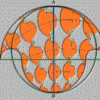
Salinon
This shape comprises four semi-circles. What is the relationship between the area of the shaded region and the area of the circle on AB as diameter?
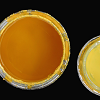
Painted Cube
Imagine a large cube made from small red cubes being dropped into a pot of yellow paint. How many of the small cubes will have yellow paint on their faces?

Tilted Squares
It's easy to work out the areas of most squares that we meet, but what if they were tilted?

Seven Squares - Group-worthy Task
Choose a couple of the sequences. Try to picture how to make the next, and the next, and the next... Can you describe your reasoning?
Perfectly Square
The sums of the squares of three related numbers is also a perfect square - can you explain why?

More Number Pyramids
When number pyramids have a sequence on the bottom layer, some interesting patterns emerge...

Number Pyramids
Try entering different sets of numbers in the number pyramids. How does the total at the top change?

Always Perfect
Show that if you add 1 to the product of four consecutive numbers the answer is ALWAYS a perfect square.

Children at Large
There are four children in a family, two girls, Kate and Sally, and two boys, Tom and Ben. How old are the children?
Leonardo's Problem
A, B & C own a half, a third and a sixth of a coin collection. Each grab some coins, return some, then share equally what they had put back, finishing with their own share. How rich are they?
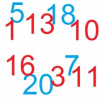
Take Three from Five
Caroline and James pick sets of five numbers. Charlie tries to find three that add together to make a multiple of three. Can they stop him?


Remainders
I'm thinking of a number. My number is both a multiple of 5 and a multiple of 6. What could my number be?

Proof Sorter - Quadratic Equation
This is an interactivity in which you have to sort the steps in the completion of the square into the correct order to prove the formula for the solutions of quadratic equations.
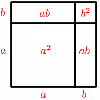
Proofs with Pictures
Some diagrammatic 'proofs' of algebraic identities and inequalities.

Shopping Basket
The items in the shopping basket add and multiply to give the same amount. What could their prices be?

What's it Worth?
There are lots of different methods to find out what the shapes are worth - how many can you find?

1 Step 2 Step
Liam's house has a staircase with 12 steps. He can go down the steps one at a time or two at time. In how many different ways can Liam go down the 12 steps?

Attractive Tablecloths
Charlie likes tablecloths that use as many colours as possible, but insists that his tablecloths have some symmetry. Can you work out how many colours he needs for different tablecloth designs?

Marbles in a Box
How many winning lines can you make in a three-dimensional version of noughts and crosses?

Number Rules - OK
Can you produce convincing arguments that a selection of statements about numbers are true?
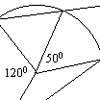
Lens Angle
Find the missing angle between the two secants to the circle when the two angles at the centre subtended by the arcs created by the intersections of the secants and the circle are 50 and 120 degrees.

American Billions
Play the divisibility game to create numbers in which the first two digits make a number divisible by 2, the first three digits make a number divisible by 3...

Iff
Take a triangular number, multiply it by 8 and add 1. What is special about your answer? Can you prove it?

Why 24?
Take any prime number greater than 3 , square it and subtract one. Working on the building blocks will help you to explain what is special about your results.

What's Possible?
Many numbers can be expressed as the difference of two perfect squares. What do you notice about the numbers you CANNOT make?
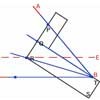
Angle Trisection
It is impossible to trisect an angle using only ruler and compasses but it can be done using a carpenter's square.
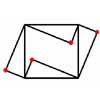
Zig Zag
Four identical right angled triangles are drawn on the sides of a square. Two face out, two face in. Why do the four vertices marked with dots lie on one line?
Unit Interval
Take any two numbers between 0 and 1. Prove that the sum of the numbers is always less than one plus their product?

How Old Am I?
In 15 years' time my age will be the square of my age 15 years ago. Can you work out my age, and when I had other special birthdays?

Differences
Can you guarantee that, for any three numbers you choose, the product of their differences will always be an even number?

Quad in Quad
Join the midpoints of a quadrilateral to get a new quadrilateral. What is special about it?

Legs Eleven
Take any four digit number. Move the first digit to the end and move the rest along. Now add your two numbers. Did you get a multiple of 11?
Rule of Three
If it takes four men one day to build a wall, how long does it take 60,000 men to build a similar wall?

Summing Consecutive Numbers
15 = 7 + 8 and 10 = 1 + 2 + 3 + 4. Can you say which numbers can be expressed as the sum of two or more consecutive integers?
Latin Numbers
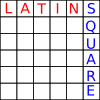
Can you create a Latin Square from multiples of a six digit number?
Common Divisor
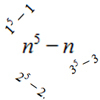
Find the largest integer which divides every member of the following sequence: 1^5-1, 2^5-2, 3^5-3, ... n^5-n.
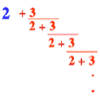
There's a Limit
Explore the continued fraction: 2+3/(2+3/(2+3/2+...)) What do you notice when successive terms are taken? What happens to the terms if the fraction goes on indefinitely?
Square Mean
Is the mean of the squares of two numbers greater than, or less than, the square of their means?
Cosines Rule
Three points A, B and C lie in this order on a line, and P is any point in the plane. Use the Cosine Rule to prove the following statement.
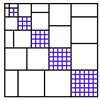
Picture Story
Can you see how this picture illustrates the formula for the sum of the first six cube numbers?