 Links to the NRICH website Home page

30 April (Primary), 1 May (Secondary)
Resources tagged with: Reasoning, convincing and proving
There are 168 results
Broad Topics > Thinking mathematically > Reasoning, convincing and proving
Olympic Measures
These Olympic quantities have been jumbled up! Can you put them back together again?


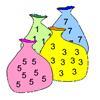
What Numbers Can We Make Now?
Imagine we have four bags containing numbers from a sequence. What numbers can we make now?

Three Neighbours
Take three consecutive numbers and add them together. What do you notice?
Square Subtraction
Look at what happens when you take a number, square it and subtract your answer. What kind of number do you get? Can you prove it?

Take Three Numbers
What happens when you add three numbers together? Will your answer be odd or even? How do you know?
So It's Times!
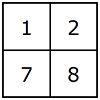
How will you decide which way of flipping over and/or turning the grid will give you the highest total?
Place Your Orders
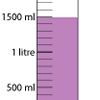
Can you rank these sets of quantities in order, from smallest to largest? Can you provide convincing evidence for your rankings?
Largest Even
How would you create the largest possible two-digit even number from the digit I've given you and one of your choice?

What Numbers Can We Make?
Imagine we have four bags containing a large number of 1s, 4s, 7s and 10s. What numbers can we make?

Missing Multipliers
What is the smallest number of answers you need to reveal in order to work out the missing headers?

Always a Multiple?
Think of a two digit number, reverse the digits, and add the numbers together. Something special happens...


Times Tables Shifts
In this activity, the computer chooses a times table and shifts it. Can you work out the table and the shift each time?

Three Dice
Investigate the sum of the numbers on the top and bottom faces of a line of three dice. What do you notice?

Tower of Hanoi
The Tower of Hanoi is an ancient mathematical challenge. Working on the building blocks may help you to explain the patterns you notice.

Cyclic Quadrilaterals
Draw some quadrilaterals on a 9-point circle and work out the angles. Is there a theorem?
Strike it Out
Use your addition and subtraction skills, combined with some strategic thinking, to beat your partner at this game.

Pythagoras Proofs
Can you make sense of these three proofs of Pythagoras' Theorem?

The Greedy Algorithm
The Egyptians expressed all fractions as the sum of different unit fractions. The Greedy Algorithm might provide us with an efficient way of doing this.

Multiples Sudoku
Each clue in this Sudoku is the product of the two numbers in adjacent cells.

Power Mad!
Powers of numbers behave in surprising ways. Take a look at some of these and try to explain why they are true.

Elevenses
How many pairs of numbers can you find that add up to a multiple of 11? Do you notice anything interesting about your results?

Magic Vs
Can you put the numbers 1-5 in the V shape so that both 'arms' have the same total?

Crossed Ends
Crosses can be drawn on number grids of various sizes. What do you notice when you add opposite ends?

All in a Jumble
My measurements have got all jumbled up! Swap them around and see if you can find a combination where every measurement is valid.
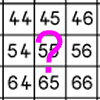
What Do You Need?
Four of these clues are needed to find the chosen number on this grid and four are true but do nothing to help in finding the number. Can you sort out the clues and find the number?
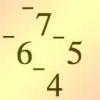
Consecutive Negative Numbers
Do you notice anything about the solutions when you add and/or subtract consecutive negative numbers?
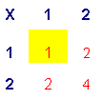
Triangle Numbers
Take a look at the multiplication square. The first eleven triangle numbers have been identified. Can you see a pattern? Does the pattern continue?

Product Sudoku
The clues for this Sudoku are the product of the numbers in adjacent squares.


An Easy Way to Multiply by 10?
Do you agree with Badger's statements? Is Badger's reasoning 'watertight'? Why or why not?

Arithmagons
Can you find the values at the vertices when you know the values on the edges?

Tilted Squares
It's easy to work out the areas of most squares that we meet, but what if they were tilted?

Seven Squares - Group-worthy Task
Choose a couple of the sequences. Try to picture how to make the next, and the next, and the next... Can you describe your reasoning?

Your Number Is...
Think of a number and follow the machine's instructions... I know what your number is! Can you explain how I know?

More Number Pyramids
When number pyramids have a sequence on the bottom layer, some interesting patterns emerge...

Special Numbers
My two digit number is special because adding the sum of its digits to the product of its digits gives me my original number. What could my number be?

Children at Large
There are four children in a family, two girls, Kate and Sally, and two boys, Tom and Ben. How old are the children?

Make 37
Four bags contain a large number of 1s, 3s, 5s and 7s. Can you pick any ten numbers from the bags so that their total is 37?
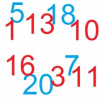
Take Three from Five
Caroline and James pick sets of five numbers. Charlie tries to find three that add together to make a multiple of three. Can they stop him?

Remainders
I'm thinking of a number. My number is both a multiple of 5 and a multiple of 6. What could my number be?

Sealed Solution
Ten cards are put into five envelopes so that there are two cards in each envelope. The sum of the numbers inside it is written on each envelope. What numbers could be inside the envelopes?

Think of Two Numbers
Think of two whole numbers under 10, and follow the steps. I can work out both your numbers very quickly. How?

Shopping Basket
The items in the shopping basket add and multiply to give the same amount. What could their prices be?

Marbles in a Box
How many winning lines can you make in a three-dimensional version of noughts and crosses?

American Billions
Play the divisibility game to create numbers in which the first two digits make a number divisible by 2, the first three digits make a number divisible by 3...

Differences
Can you guarantee that, for any three numbers you choose, the product of their differences will always be an even number?

Legs Eleven
Take any four digit number. Move the first digit to the end and move the rest along. Now add your two numbers. Did you get a multiple of 11?
Rule of Three
If it takes four men one day to build a wall, how long does it take 60,000 men to build a similar wall?