 Links to the NRICH website Home page

30 April (Primary), 1 May (Secondary)
Resources tagged with: Dynamic geometry
There are 20 NRICH Mathematical resources connected to Dynamic geometry, you may find related items under Physical and digital manipulatives.
Broad Topics > Physical and digital manipulatives > Dynamic geometry
Trapezium Four
The diagonals of a trapezium divide it into four parts. Can you create a trapezium where three of those parts are equal in area?


Quad in Quad
Join the midpoints of a quadrilateral to get a new quadrilateral. What is special about it?

Bendy Quad
Four rods are hinged at their ends to form a convex quadrilateral. Investigate the different shapes that the quadrilateral can take. Be patient this problem may be slow to load.

Using Geogebra
Never used GeoGebra before? This article for complete beginners will help you to get started with this free dynamic geometry software.

Points in Pairs
Move the point P to see how P' moves. Then use your insights to calculate a missing length.

Two Shapes & Printer Ink
If I print this page which shape will require the more yellow ink?
The Rescaled Map
We use statistics to give ourselves an informed view on a subject of interest. This problem explores how to scale countries on a map to represent characteristics other than land area.
Rotations Are Not Single Round Here
I noticed this about streamers that have rotation symmetry : if there was one centre of rotation there always seems to be a second centre that also worked. Can you find a design that has only one centre of rotation ? Or if you thought that was impossible, could you say why ?
One Reflection Implies Another
When a strip has vertical symmetry there always seems to be a second place where a mirror line could go. Perhaps you can find a design that has only one mirror line across it. Or, if you thought that was impossible, could you explain why ?

A Roll of Patterned Paper
A design is repeated endlessly along a line - rather like a stream of paper coming off a roll. Make a strip that matches itself after rotation, or after reflection

Secants Interactivity
Move the ends of the lines at points B and D around the circle and find the relationship between the length of the line segments PA, PB, PC, and PD. The length of each of the line segments is recorded next to the diagram.
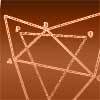
Napoleon's Theorem
Triangle ABC has equilateral triangles drawn on its edges. Points P, Q and R are the centres of the equilateral triangles. What can you prove about the triangle PQR?
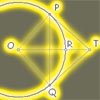
Three Balls
A circle has centre O and angle POR = angle QOR. Construct tangents at P and Q meeting at T. Draw a circle with diameter OT. Do P and Q lie inside, or on, or outside this circle?
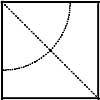
The Medieval Octagon
Medieval stonemasons used a method to construct octagons using ruler and compasses... Is the octagon regular? Proof please.
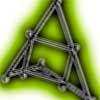
Arrowhead
The points P, Q, R and S are the midpoints of the edges of a non-convex quadrilateral.What do you notice about the quadrilateral PQRS and its area?
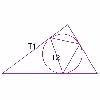
Triangle Incircle Iteration
Keep constructing triangles in the incircle of the previous triangle. What happens?
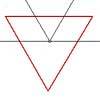
Napoleon's Hat
Three equilateral triangles ABC, AYX and XZB are drawn with the point X a moveable point on AB. The points P, Q and R are the centres of the three triangles. What can you say about triangle PQR?
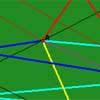
Cushion Ball
The shortest path between any two points on a snooker table is the straight line between them but what if the ball must bounce off one wall, or 2 walls, or 3 walls?
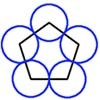
Polycircles
Show that for any triangle it is always possible to construct 3 touching circles with centres at the vertices. Is it possible to construct touching circles centred at the vertices of any polygon?
Fixing It
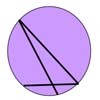
A and B are two fixed points on a circle and RS is a variable diamater. What is the locus of the intersection P of AR and BS?