 Links to the NRICH website Home page

30 April (Primary), 1 May (Secondary)
Resources tagged with: Dice
There are 6 NRICH Mathematical resources connected to Dice, you may find related items under Physical and digital manipulatives.
Broad Topics > Physical and digital manipulatives > Dice
Non-transitive Dice
Alison and Charlie are playing a game. Charlie wants to go first so Alison lets him. Was that such a good idea?


Troublesome Dice
When dice land edge-up, we usually roll again. But what if we didn't...?
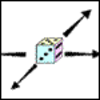
Dice, Routes and Pathways
This article for teachers discusses examples of problems in which there is no obvious method but in which children can be encouraged to think deeply about the context and extend their ability to think mathematically, especially geometrically.

Game of PIG - Sixes
Can you beat Piggy in this simple dice game? Can you figure out Piggy's strategy, and is there a better one?
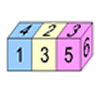
Dicing with Numbers
In how many ways can you arrange three dice side by side on a surface so that the sum of the numbers on each of the four faces (top, bottom, front and back) is equal?
How Many Dice?
A standard die has the numbers 1, 2 and 3 are opposite 6, 5 and 4 respectively so that opposite faces add to 7? If you make standard dice by writing 1, 2, 3, 4, 5, 6 on blank cubes you will find there are 2 and only 2 different standard dice. Can you prove this ?