 Links to the NRICH website Home page

30 April (Primary), 1 May (Secondary)
Resources tagged with: Dice
There are 32 results
Broad Topics > Physical and digital manipulatives > Dice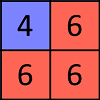
Six Ten Total
This challenge combines addition, multiplication, perseverance and even proof.



Double or Halve?
Throw the dice and decide whether to double or halve the number. Will you be the first to reach the target?
Five Steps to 50
Use five steps to count forwards or backwards in 1s or 10s to get to 50. What strategies did you use?

Round the Dice Decimals 1
Use two dice to generate two numbers with one decimal place. What happens when you round these numbers to the nearest whole number?


Round the Dice Decimals 2
What happens when you round these numbers to the nearest whole number?

Round the Four Dice
This activity involves rounding four-digit numbers to the nearest thousand.

The Dice Train
This dice train has been made using specific rules. How many different trains can you make?
Dice in a Corner
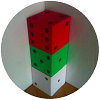
How could you arrange at least two dice in a stack so that the total of the visible spots is 18?

Three Dice
Investigate the sum of the numbers on the top and bottom faces of a line of three dice. What do you notice?
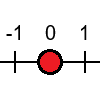
Tug Harder!
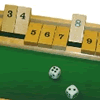
In this game, you can add, subtract, multiply or divide the numbers on the dice. Which will you do so that you get to the end of the number line first?
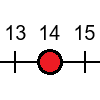
Tug of War
Can you use the numbers on the dice to reach your end of the number line before your partner beats you?

First Connect Three
Add or subtract the two numbers on the spinners and try to complete a row of three. Are there some numbers that are good to aim for?


The Twelve Pointed Star Game
Have a go at this game which involves throwing two dice and adding their totals. Where should you place your counters to be more likely to win?
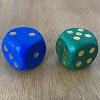
Two Dice
Find all the numbers that can be made by adding the dots on two dice.

Roll These Dice
Roll two red dice and a green dice. Add the two numbers on the red dice and take away the number on the green. What are all the different possible answers?

Roll over the Dice
Watch this video to see how to roll the dice. Now it's your turn! What do you notice about the dice numbers you have recorded?
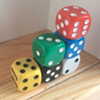
Dice Stairs
Can you make dice stairs using the rules stated? How do you know you have all the possible stairs?
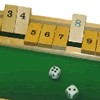
Shut the Box for Two
Shut the Box game for an adult and child. Can you turn over the cards which match the numbers on the dice?

KS2 Teacher Playing with Dice Collection

Path of Discovery Series: 2. First Steps
This article takes a closer look at some of the toys and games that can enhance a child's mathematical learning.
Dice, Routes and Pathways
This article for teachers discusses examples of problems in which there is no obvious method but in which children can be encouraged to think deeply about the context and extend their ability to think mathematically, especially geometrically.
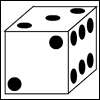
Right or Left?
Which of these dice are right-handed and which are left-handed?
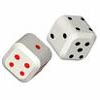
Tricky Track
In this game you throw two dice and find their total, then move the appropriate counter to the right. Which counter reaches the purple box first?

Game of PIG - Sixes
Can you beat Piggy in this simple dice game? Can you figure out Piggy's strategy, and is there a better one?
Asteroid Blast
A game for 2 people. Use your skills of addition, subtraction, multiplication and division to blast the asteroids.

Scoring with Dice
I throw three dice and get 5, 3 and 2. Add the scores on the three dice. What do you get? Now multiply the scores. What do you notice?

A Bit of a Dicey Problem
When you throw two regular, six-faced dice you have more chance of getting one particular result than any other. What result would that be? Why is this?
Add 3 Dice
Three dice are placed in a row. Find a way to turn each one so that the three numbers on top of the dice total the same as the three numbers on the front of the dice. Can you find all the ways to do this?
Taking a Die for a Walk
Investigate the numbers that come up on a die as you roll it in the direction of north, south, east and west, without going over the path it's already made.