 Links to the NRICH website Home page

30 April (Primary), 1 May (Secondary)
Resources tagged with: Interlocking cubes
There are 32 results
Broad Topics > Physical and digital manipulatives > Interlocking cubes
Triple Cubes
This challenge involves eight three-cube models made from interlocking cubes. Investigate different ways of putting the models together then compare your constructions.


Holes
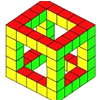
I've made some cubes and some cubes with holes in. This challenge invites you to explore the difference in the number of small cubes I've used. Can you see any patterns?
Brush Loads
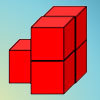
How can you arrange the 5 cubes so that you need the smallest number of Brush Loads of paint to cover them? Try with other numbers of cubes as well.
Building Blocks
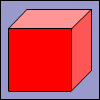
Here are some pictures of 3D shapes made from cubes. Can you make these shapes yourself?
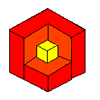
Cubes Within Cubes
We start with one yellow cube and build around it to make a 3x3x3 cube with red cubes. Then we build around that red cube with blue cubes and so on. How many cubes of each colour have we used?
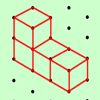
The Third Dimension
Here are four cubes joined together. How many other arrangements of four cubes can you find? Can you draw them on dotty paper?

Nine Colours
Can you use small coloured cubes to make a 3 by 3 by 3 cube so that each face of the bigger cube contains one of each colour?
Take Some ... Cubes
In this article we outline how cubes can support children in working mathematically and draw attention to tasks which exemplify this.
Cubes
This feature brings together activities which all use cubes to support your thinking.
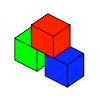
Cubes
This feature brings together tasks which make use of interlocking cubes.
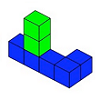
Many Ideas with a Few Cubes
This short article outlines a few activities which make use of interlocking cubes.
Three Sets of Cubes, Two Surfaces
How many models can you find which obey these rules?
Cubes Here and There
How many shapes can you build from three red and two green cubes? Can you use what you've found out to predict the number for four red and two green?
More Building with Cubes
Here are more buildings to picture in your mind's eye. Watch out - they become quite complicated!
Two on Five
Take 5 cubes of one colour and 2 of another colour. How many different ways can you join them if the 5 must touch the table and the 2 must not touch the table?
Cubist Cuts
A 3x3x3 cube may be reduced to unit cubes in six saw cuts. If after every cut you can rearrange the pieces before cutting straight through, can you do it in fewer?
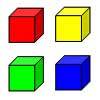
Four Colours
Kate has eight multilink cubes. She has two red ones, two yellow, two green and two blue. She wants to fit them together to make a cube so that each colour shows on each face just once.

Creating Cubes
Arrange 9 red cubes, 9 blue cubes and 9 yellow cubes into a large 3 by 3 cube. No row or column of cubes must contain two cubes of the same colour.

Wag Worms
When intergalactic Wag Worms are born they look just like a cube. Each year they grow another cube in any direction. Find all the shapes that five-year-old Wag Worms can be.
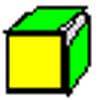
Green Cube, Yellow Cube
How can you paint the faces of these eight cubes so they can be put together to make a 2 x 2 x 2 cube that is green all over AND a 2 x 2 x 2 cube that is yellow all over?
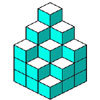
Soma - So Good
Can you mentally fit the 7 SOMA pieces together to make a cube? Can you do it in more than one way?
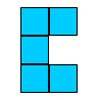
Penta Place
Penta people, the Pentominoes, always build their houses from five square rooms. I wonder how many different Penta homes you can create?

The Big Cheese
Investigate the area of 'slices' cut off this cube of cheese. What would happen if you had different-sized block of cheese to start with?
Train Carriages
Suppose there is a train with 24 carriages which are going to be put together to make up some new trains. Can you find all the ways that this can be done?
Fencing
Arrange your fences to make the largest rectangular space you can. Try with four fences, then five, then six etc.
Fencing Lambs
A thoughtful shepherd used bales of straw to protect the area around his lambs. Explore how you can arrange the bales.
New House
In this investigation, you must try to make houses using cubes. If the base must not spill over 4 squares and you have 7 cubes which stand for 7 rooms, what different designs can you come up with?
Presents
We need to wrap up this cube-shaped present, remembering that we can have no overlaps. What shapes can you find to use?
Stairs
This challenge is to design different step arrangements, which must go along a distance of 6 on the steps and must end up at 6 high.
Prompt Cards
These two group activities use mathematical reasoning - one is numerical, one geometric.
Multilink Cubes
If you had 36 cubes, what different cuboids could you make?