Links to the NRICH website Home page

30 April (Primary), 1 May (Secondary)
Resources tagged with: Triangles
There are 67 results
Broad Topics > Angles, polygons, and geometrical proof > Triangles
Name That Triangle!
Can you sketch triangles that fit in the cells in this grid? Which ones are impossible? How do you know?



Triangle or No Triangle?
Here is a selection of different shapes. Can you work out which ones are triangles, and why?

Always, Sometimes or Never? Shape
Are these statements always true, sometimes true or never true?
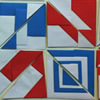
Paper Patchwork 2
Have a go at making a few of these shapes from paper in different sizes. What patterns can you create?
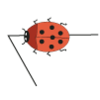
Walking Round a Triangle
This ladybird is taking a walk round a triangle. Can you see how much he has turned when he gets back to where he started?

Data Shapes
Sara and Will were sorting some pictures of shapes on cards. "I'll collect the circles," said Sara. "I'll take the red ones," answered Will. Can you see any cards they would both want?
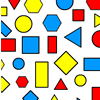
Sorting Logic Blocks
This activity focuses on similarities and differences between shapes.

Jig Shapes
Can you each work out what shape you have part of on your card? What will the rest of it look like?

Repeating Patterns
Try continuing these patterns made from triangles. Can you create your own repeating pattern?
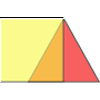
Overlaps
What does the overlap of these two shapes look like? Try picturing it in your head and then use some cut-out shapes to test your prediction.
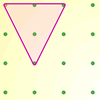
Inside Triangles
How many different triangles can you draw on the dotty grid which each have one dot in the middle?

Matching Triangles
Can you sort these triangles into three different families and explain how you did it?
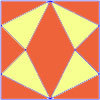
Fraction Fascination
This problem challenges you to work out what fraction of the whole area of these pictures is taken up by various shapes.
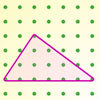
More Transformations on a Pegboard
Use the interactivity to find all the different right-angled triangles you can make by just moving one corner of the starting triangle.

Triangle Animals
How many different ways can you find to join three equilateral triangles together? Can you convince us that you have found them all?
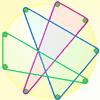
Nine-pin Triangles
How many different triangles can you make on a circular pegboard that has nine pegs?

Triangles All Around
Can you find all the different triangles on these peg boards, and find their angles?

Tangram Tangle
If you split the square into these two pieces, it is possible to fit the pieces together again to make a new shape. How many new shapes can you make?
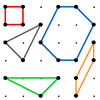
Transformations on a Pegboard
How would you move the bands on the pegboard to alter these shapes?
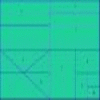
Rectangle Tangle
The large rectangle is divided into a series of smaller quadrilaterals and triangles. Can you untangle what fractional part is represented by each of the shapes?
Egyptian Rope
The ancient Egyptians were said to make right-angled triangles using a rope with twelve equal sections divided by knots. What other triangles could you make if you had a rope like this?
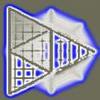
Cut it Out
Can you dissect an equilateral triangle into 6 smaller ones? What number of smaller equilateral triangles is it NOT possible to dissect a larger equilateral triangle into?
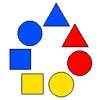
Chain of Changes
Arrange the shapes in a line so that you change either colour or shape in the next piece along. Can you find several ways to start with a blue triangle and end with a red circle?
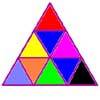
Colouring Triangles
Explore ways of colouring this set of triangles. Can you make symmetrical patterns?

Four Triangles Puzzle
Cut four triangles from a square as shown in the picture. How many different shapes can you make by fitting the four triangles back together?

Let's Investigate Triangles
Vincent and Tara are making triangles with the class construction set. They have a pile of strips of different lengths. How many different triangles can they make?
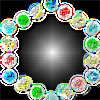
Bracelets
Investigate the different shaped bracelets you could make from 18 different spherical beads. How do they compare if you use 24 beads?

Making Maths: Equilateral Triangle Folding
Make an equilateral triangle by folding paper and use it to make patterns of your own.
Sticks and Triangles
Using different numbers of sticks, how many different triangles are you able to make? Can you make any rules about the numbers of sticks that make the most triangles?
Tessellating Transformations
Can you find out how the 6-triangle shape is transformed in these tessellations? Will the tessellations go on for ever? Why or why not?
Board Block
Take it in turns to make a triangle on the pegboard. Can you block your opponent?
Triangle Pin-down
Use the interactivity to investigate what kinds of triangles can be drawn on peg boards with different numbers of pegs.
Liethagoras' Theorem
Liethagoras, Pythagoras' cousin (!), was jealous of Pythagoras and came up with his own theorem. Read this article to find out why other mathematicians laughed at him.
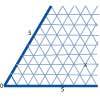
Cartesian Isometric
The graph below is an oblique coordinate system based on 60 degree angles. It was drawn on isometric paper. What kinds of triangles do these points form?
Timber!
How can the school caretaker be sure that the tree would miss the school buildings if it fell?

Uncanny Triangles
Can you help the children find the two triangles which have the lengths of two sides numerically equal to their areas?
Triangle Edges
How many triangles can you make using sticks that are 3cm, 4cm and 5cm long?

Inside Seven Squares
What is the total area of the four outside triangles which are outlined in red in this arrangement of squares inside each other?
Triangle Island
You have pitched your tent (the red triangle) on an island. Can you move it to the position shown by the purple triangle making sure you obey the rules?

Tri-five
Find all the different shapes that can be made by joining five equilateral triangles edge to edge.
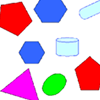
Part the Polygons
Draw three straight lines to separate these shapes into four groups - each group must contain one of each shape.
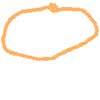
Three Fingers and a Loop of String
Using a loop of string stretched around three of your fingers, what different triangles can you make? Draw them and sort them into groups.
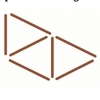
Seven Sticks
Explore the triangles that can be made with seven sticks of the same length.

Cut and Make
Cut a square of paper into three pieces as shown. Now,can you use the 3 pieces to make a large triangle, a parallelogram and the square again?
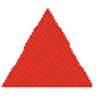
Tessellating Triangles
Can you make these equilateral triangles fit together to cover the paper without any gaps between them? Can you tessellate isosceles triangles?
Cutting Corners
Can you make the most extraordinary, the most amazing, the most unusual patterns/designs from these triangles which are made in a special way?