 Links to the NRICH website Home page

30 April (Primary), 1 May (Secondary)
Resources tagged with: Multiplication and division
There are 181 results
Broad Topics > Calculations and numerical methods > Multiplication and division
The Remainders Game
Play this game and see if you can figure out the computer's chosen number.


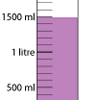
Oh! Harry!
A group of children are using measuring cylinders but they lose the labels. Can you help relabel them?
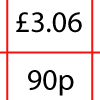
How Much Did it Cost?
Use your logical-thinking skills to deduce how much Dan's crisps and ice-cream cost altogether.
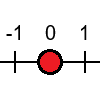
Tug Harder!
In this game, you can add, subtract, multiply or divide the numbers on the dice. Which will you do so that you get to the end of the number line first?
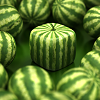
Shape Times Shape
These eleven shapes each stand for a different number. Can you use the number sentences to work out what they are?
Secret Number
Annie and Ben are playing a game with a calculator. What was Annie's secret number?
Four Go
This challenge is a game for two players. Choose two of the numbers to multiply or divide, then mark your answer on the number line. Can you get four in a row?
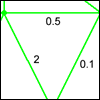
Route Product
Find the product of the numbers on the routes from A to B. Which route has the smallest product? Which the largest?
Method in Multiplying Madness?
Watch our videos of multiplication methods that you may not have met before. Can you make sense of them?

Making Longer, Making Shorter
Ahmed is making rods using different numbers of cubes. Which rod is twice the length of his first rod?
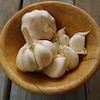
Growing Garlic
Ben and his mum are planting garlic. Can you find out how many cloves of garlic they might have had?
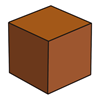
What's in the Box?
This big box multiplies anything that goes inside it by the same number. If you know the numbers that come out, what multiplication might be going on in the box?
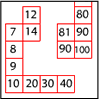
Multiplication Square Jigsaw
Can you complete this jigsaw of the multiplication square?
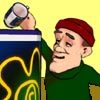
Little Man
The Man is much smaller than us. Can you use the picture of him next to a mug to estimate his height and how much tea he drinks?
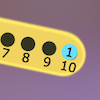
Are You Well Balanced?
Can you work out how to make each side of this balance equally balanced? You can put more than one weight on a hook.
An Easy Way to Multiply by 10?
Do you agree with Badger's statements? Is Badger's reasoning 'watertight'? Why or why not?
Carrying Cards
These sixteen children are standing in four lines of four, one behind the other. They are each holding a card with a number on it. Can you work out the missing numbers?
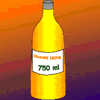
Orange Drink
A 750 ml bottle of concentrated orange squash is enough to make fifteen 250 ml glasses of diluted orange drink. How much water is needed to make 10 litres of this drink?
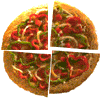
Fair Feast
Here is a picnic that Petros and Michael are going to share equally. Can you tell us what each of them will have?
Lots of Lollies
Frances and Rishi were given a bag of lollies. They shared them out evenly and had one left over. How many lollies could there have been in the bag?
Share Bears
Yasmin and Zach have some bears to share. Which numbers of bears can they share so that there are none left over?
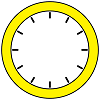
A Mixed-up Clock
There is a clock-face where the numbers have become all mixed up. Can you find out where all the numbers have got to from these ten statements?
The Deca Tree
Find out what a Deca Tree is and then work out how many leaves there will be after the woodcutter has cut off a trunk, a branch, a twig and a leaf.
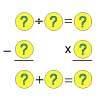
A Square of Numbers
Can you put the numbers 1 to 8 into the circles so that the four calculations are correct?
Trebling
Can you replace the letters with numbers? Is there only one solution in each case?

The Brown Family
Use the information about Sally and her brother to find out how many children there are in the Brown family.

Which Is Quicker?
Which is quicker, counting up to 30 in ones or counting up to 300 in tens? Why?

Remainders
I'm thinking of a number. My number is both a multiple of 5 and a multiple of 6. What could my number be?
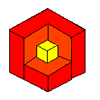
Cubes Within Cubes
We start with one yellow cube and build around it to make a 3x3x3 cube with red cubes. Then we build around that red cube with blue cubes and so on. How many cubes of each colour have we used?
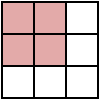
Multiplication Squares
Can you work out the arrangement of the digits in the square so that the given products are correct? The numbers 1 - 9 may be used once and once only.
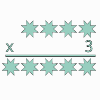
All the Digits
This multiplication uses each of the digits 0 - 9 once and once only. Using the information given, can you replace the stars in the calculation with figures?

Four Goodness Sake
Use 4 four times with simple operations so that you get the answer 12. Can you make 15, 16 and 17 too?
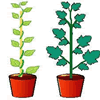
The Tomato and the Bean
At the beginning of May Tom put his tomato plant outside. On the same day he sowed a bean in another pot. When will the two be the same height?

Mystery Matrix
Can you fill in this table square? The numbers 2 -12 were used to generate it with just one number used twice.
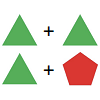
Super Shapes
The value of the circle changes in each of the following problems. Can you discover its value in each problem?
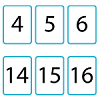
Twenty Divided Into Six
Katie had a pack of 20 cards numbered from 1 to 20. She arranged the cards into 6 unequal piles where each pile added to the same total. What was the total and how could this be done?
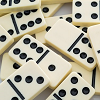
Amy's Dominoes
Amy has a box containing domino pieces but she does not think it is a complete set. Which of her domino pieces are missing?
Pumpkin Pie Problem
Peter wanted to make two pies for a party. His mother had a recipe for him to use. However, she always made 80 pies at a time. Did Peter have enough ingredients to make two pumpkin pies?
Forgot the Numbers
On my calculator I divided one whole number by another whole number and got the answer 3.125. If the numbers are both under 50, what are they?

Make 100
Find at least one way to put in some operation signs to make these digits come to 100.
Zios and Zepts
On the planet Vuv there are two sorts of creatures. The Zios have 3 legs and the Zepts have 7 legs. The great planetary explorer Nico counted 52 legs. How many Zios and how many Zepts were there?
Highest and Lowest
Put operations signs between the numbers 3 4 5 6 to make the highest possible number and lowest possible number.

The Puzzling Sweet Shop
There were chews for 2p, mini eggs for 3p, Chocko bars for 5p and lollypops for 7p in the sweet shop. What could each of the children buy with their money?

Catrina's Cards
How would you find out how many football cards Catrina has collected?

The Amazing Splitting Plant
Can you work out how many flowers there will be on the Amazing Splitting Plant after it has been growing for six weeks?

Magic Plant
On Friday the magic plant was only 2 centimetres tall. Every day it doubled its height. How tall was it on Monday?
Doplication
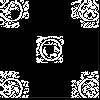
We can arrange dots in a similar way to the 5 on a dice and they usually sit quite well into a rectangular shape. How many altogether in this 3 by 5? What happens for other sizes?

Pebbles
Place four pebbles on the sand in the form of a square. Keep adding as few pebbles as necessary to double the area. How many extra pebbles are added each time?