 Links to the NRICH website Home page

30 April (Primary), 1 May (Secondary)
Resources tagged with: Theoretical probability
There are 38 NRICH Mathematical resources connected to Theoretical probability, you may find related items under Probability.
Broad Topics > Probability > Theoretical probability
Who's the Winner?
When two closely matched teams play each other, what is the most likely result?



At Least One...
Imagine flipping a coin a number of times. Can you work out the probability you will get a head on at least one of the flips?
What Does Random Look Like?
Engage in a little mathematical detective work to see if you can spot the fakes.

Mathsland National Lottery
Can you work out the probability of winning the Mathsland National Lottery?

Same Number!
If everyone in your class picked a number from 1 to 225, do you think any two people would pick the same number?
Last One Standing
Imagine a room full of people who keep flipping coins until they get a tail. Will anyone get six heads in a row?

Which Spinners?
Can you work out which spinners were used to generate the frequency charts?

Interactive Spinners
This interactivity invites you to make conjectures and explore probabilities of outcomes related to two independent events.

The Birthday Bet
The next ten people coming into a store will be asked their birthday. If the prize is £20, would you bet £1 that two of these ten people will have the same birthday ?

The Better Choice
Here are two games you can play. Which offers the better chance of winning?

Cosy Corner
Six balls are shaken. You win if at least one red ball ends in a corner. What is the probability of winning?
Two's Company
Seven balls are shaken. You win if the two blue balls end up touching. What is the probability of winning?

Flippin' Discs
Discs are flipped in the air. You win if all the faces show the same colour. What is the probability of winning?
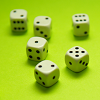
Chances Are
Which of these games would you play to give yourself the best possible chance of winning a prize?

In a Box
Chris and Jo put two red and four blue ribbons in a box. They each pick a ribbon from the box without looking. Jo wins if the two ribbons are the same colour. Is the game fair?
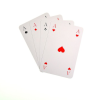
A Probability Conundrum
What do we mean by probability? This simple problem may challenge your ideas...
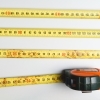
Tools for Thinking about Probability
Can you design your own probability scale?
How do you describe the different parts?
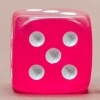
What do you know about Probability? (2)
What are the likelihoods of different events when you roll a dice?
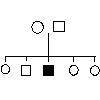
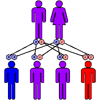
Peas in a Pod
What is the chance this pea plant will look like its parents?
Distribution Differences
How could you compare different situation where something random happens ? What sort of things might be the same ? What might be different ?
Misunderstanding Randomness
Which of these ideas about randomness are actually correct?
Can't Find a Coin?
Can you generate a set of random results? Can you fool the random simulator?

The Random World
Think that a coin toss is 50-50 heads or tails? Read on to appreciate the ever-changing and random nature of the world in which we live.
Taking Chances
This article, for students and teachers, is mainly about probability, the mathematical way of looking at random chance and is a shorter version of Taking Chances Extended.
Taking Chances Extended
This article, for students and teachers, is mainly about probability, the mathematical way of looking at random chance.
Bet You a Million
Heads or Tails - the prize doubles until you win it. How much would you pay to play?
Voting Paradox
Some relationships are transitive, such as `if A>B and B>C then it follows that A>C', but some are not. In a voting system, if A beats B and B beats C should we expect A to beat C?
Football World Cup Simulation
A maths-based Football World Cup simulation for teachers and students to use.

Thank Your Lucky Stars
A counter is placed in the bottom right hand corner of a grid. You toss a coin and move the star according to the following rules: ... What is the probability that you end up in the top left-hand corner of the grid?
Nine or Ten?
Is a score of 9 more likely than a score of 10 when you roll three dice?
Scratch Cards
To win on a scratch card you have to uncover three numbers that add up to more than fifteen. What is the probability of winning a prize?
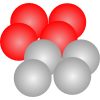
Fixing the Odds
You have two bags, four red balls and four white balls. You must put all the balls in the bags although you are allowed to have one bag empty. How should you distribute the balls between the two bags so as to make the probability of choosing a red ball as small as possible and what will the probability be in that case?
Win or Lose?
A gambler bets half the money in his pocket on the toss of a coin, winning an equal amount for a head and losing his money if the result is a tail. After 2n plays he has won exactly n times. Has he more money than he started with?
Coin Tossing Games
You and I play a game involving successive throws of a fair coin. Suppose I pick HH and you pick TH. The coin is thrown repeatedly until we see either two heads in a row (I win) or a tail followed by a head (you win). What is the probability that you win?

Marbles and Bags
Two bags contain different numbers of red and blue marbles. A marble is removed from one of the bags. The marble is blue. What is the probability that it was removed from bag A?
Gambling at Monte Carlo
A man went to Monte Carlo to try and make his fortune. Is his strategy a winning one?