 Links to the NRICH website Home page

30 April (Primary), 1 May (Secondary)
Resources tagged with: Length/distance
There are 21 results
Broad Topics > Measuring and calculating with units > Length/distance
Olympic Measures
These Olympic quantities have been jumbled up! Can you put them back together again?


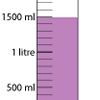
Place Your Orders
Can you rank these sets of quantities in order, from smallest to largest? Can you provide convincing evidence for your rankings?

Speed-time Problems at the Olympics
Have you ever wondered what it would be like to race against Usain Bolt?

A Question of Scale
Use your skill and knowledge to place various scientific lengths in order of size. Can you judge the length of objects with sizes ranging from 1 Angstrom to 1 million km with no wrong attempts?
All in a Jumble
My measurements have got all jumbled up! Swap them around and see if you can find a combination where every measurement is valid.
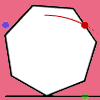
Up and Across
Experiment with the interactivity of "rolling" regular polygons, and explore how the different positions of the dot affects its vertical and horizontal movement at each stage.

How Far Does it Move?
Experiment with the interactivity of "rolling" regular polygons, and explore how the different positions of the red dot affects the distance it travels at each stage.

Rolling Around
A circle rolls around the outside edge of a square so that its circumference always touches the edge of the square. Can you describe the locus of the centre of the circle?

Alternative Record Book
In which Olympic event does a human travel fastest? Decide which events to include in your Alternative Record Book.

2010: A Year of Investigations
This article for teachers suggests ideas for activities built around 10 and 2010.

Four on the Road
Four vehicles travel along a road one afternoon. Can you make sense of the graphs showing their motion?

Uniform Units
Can you choose your units so that a cube has the same numerical value for it volume, surface area and total edge length?
Where Am I?
From the information you are asked to work out where the picture was taken. Is there too much information? How accurate can your answer be?

Swimmers
Swimmers in opposite directions cross at 20m and at 30m from each end of a swimming pool. How long is the pool ?
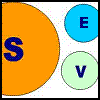
A Scale for the Solar System
The Earth is further from the Sun than Venus, but how much further? Twice as far? Ten times?

Pentagonal
Can you prove that the sum of the distances of any point inside a square from its sides is always equal (half the perimeter)? Can you prove it to be true for a rectangle or a hexagon?
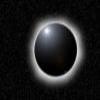
Eclipses of the Sun
Mathematics has allowed us now to measure lots of things about eclipses and so calculate exactly when they will happen, where they can be seen from, and what they will look like.

Paradoxes
A paradox is a statement that seems to be both untrue and true at the same time. This article looks at a few examples and challenges you to investigate them for yourself.
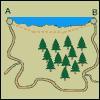
N Is a Number
N people visit their friends staying N kilometres along the coast. Some walk along the cliff path at N km an hour, the rest go by car. How long is the road?

Walk and Ride
How far have these students walked by the time the teacher's car reaches them after their bus broke down?

On the Road
Four vehicles travelled on a road. What can you deduce from the times that they met?