 Links to the NRICH website Home page

30 April (Primary), 1 May (Secondary)
Resources tagged with: Rotations
There are 33 results
Broad Topics > Transformations and constructions > Rotations

National Flags
This problem explores the shapes and symmetries in some national flags.



Attractive Rotations
Here is a chance to create some attractive images by rotating shapes through multiples of 90 degrees, or 30 degrees, or 72 degrees or...
...on the Wall
Explore the effect of reflecting in two intersecting mirror lines.
Transformation Game
Why not challenge a friend to play this transformation game?
Coordinate Challenge
Use the clues about the symmetrical properties of these letters to place them on the grid.

Rollin' Rollin' Rollin'
Two circles of equal radius touch at P. One circle is fixed whilst the other moves, rolling without slipping, all the way round. How many times does the moving coin revolve before returning to P?

John's Train Is on Time
A train leaves on time. After it has gone 8 miles (at 33mph) the driver looks at his watch and sees that the hour hand is exactly over the minute hand. When did the train leave the station?

Shady Symmetry
How many different symmetrical shapes can you make by shading triangles or squares?
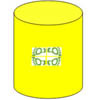
Paint Rollers for Frieze Patterns.
Proofs that there are only seven frieze patterns involve complicated group theory. The symmetries of a cylinder provide an easier approach.

2010: A Year of Investigations
This article for teachers suggests ideas for activities built around 10 and 2010.

Hexpentas
How many different ways can you find of fitting five hexagons together? How will you know you have found all the ways?
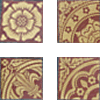
Tiles in a Public Building
What is the same and what is different about these tiling patterns and how do they contribute to the floor as a whole?


Flip
Can you picture where this letter "F" will be on the grid if you flip it in these different ways?
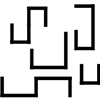
Shape Mapping
What is the relationship between these first two shapes? Which shape relates to the third one in the same way? Can you explain why?
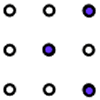
Peg Rotation
Can you work out what kind of rotation produced this pattern of pegs in our pegboard?
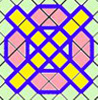
Making Maths: Indian Window Screen
Can you recreate this Indian screen pattern? Can you make up similar patterns of your own?
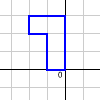
Simplifying Transformations
How many different transformations can you find made up from combinations of R, S and their inverses? Can you be sure that you have found them all?
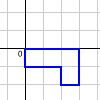
Combining Transformations
Does changing the order of transformations always/sometimes/never produce the same transformation?
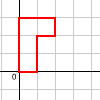
Decoding Transformations
See the effects of some combined transformations on a shape. Can you describe what the individual transformations do?
Lafayette
What mathematical words can be used to describe this floor covering? How many different shapes can you see inside this photograph?
Coordinating Classroom Coordinates
This article describes a practical approach to enhance the teaching and learning of coordinates.
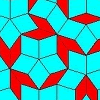
Shaping up with Tessellations
This article describes the scope for practical exploration of tessellations both in and out of the classroom. It seems a golden opportunity to link art with maths, allowing the creative side of your children to take over.

Transforming the Letters
What happens to these capital letters when they are rotated through one half turn, or flipped sideways and from top to bottom?
The Frieze Tree
Patterns that repeat in a line are strangely interesting. How many types are there and how do you tell one type from another?
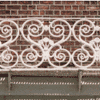
Frieze Patterns in Cast Iron
A gallery of beautiful photos of cast ironwork friezes in Australia with a mathematical discussion of the classification of frieze patterns.
Penta Play
A shape and space game for 2, 3 or 4 players. Be the last person to be able to place a pentomino piece on the playing board.
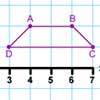
Transformation Tease
What are the coordinates of this shape after it has been transformed in the ways described? Compare these with the original coordinates. What do you notice about the numbers?
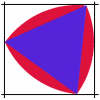
Rolling Triangle
The triangle ABC is equilateral. The arc AB has centre C, the arc BC has centre A and the arc CA has centre B. Explain how and why this shape can roll along between two parallel tracks.
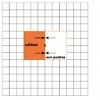
Weighty Problem
The diagram shows a very heavy kitchen cabinet. It cannot be lifted but it can be pivoted around a corner. The task is to move it, without sliding, in a series of turns about the corners so that it is facing the other way round.
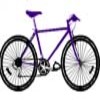
Illusion
A security camera, taking pictures each half a second, films a cyclist going by. In the film, the cyclist appears to go forward while the wheels appear to go backwards. Why?

Clock Hands
This investigation explores using different shapes as the hands of the clock. What things occur as the the hands move.