 Links to the NRICH website Home page

30 April (Primary), 1 May (Secondary)
Resources tagged with: Rotations
There are 23 NRICH Mathematical resources connected to Rotations, you may find related items under Transformations and constructions.
Broad Topics > Transformations and constructions > Rotations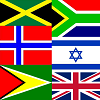
National Flags
This problem explores the shapes and symmetries in some national flags.


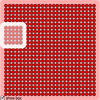
Poly Plug Pattern
Create a pattern on the small grid. How could you extend your pattern on the larger grid?
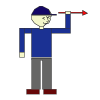
Turning Man
Use the interactivity to find out how many quarter turns the man must rotate through to look like each of the pictures.
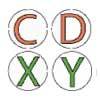
Coordinate Challenge
Use the clues about the symmetrical properties of these letters to place them on the grid.

2010: A Year of Investigations
This article for teachers suggests ideas for activities built around 10 and 2010.

Hexpentas
How many different ways can you find of fitting five hexagons together? How will you know you have found all the ways?
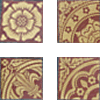
Tiles in a Public Building
What is the same and what is different about these tiling patterns and how do they contribute to the floor as a whole?

Animated Triangles
Watch this "Notes on a Triangle" film. Can you recreate parts of the film using cut-out triangles?

Flip
Can you picture where this letter "F" will be on the grid if you flip it in these different ways?
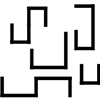
Shape Mapping
What is the relationship between these first two shapes? Which shape relates to the third one in the same way? Can you explain why?
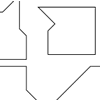
Rearrange the Square
We can cut a small triangle off the corner of a square and then fit the two pieces together. Can you work out how these shapes are made from the two pieces?
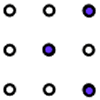
Peg Rotation
Can you work out what kind of rotation produced this pattern of pegs in our pegboard?
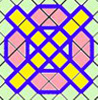
Making Maths: Indian Window Screen
Can you recreate this Indian screen pattern? Can you make up similar patterns of your own?

Watch Those Wheels
Have you ever noticed the patterns in car wheel trims? These questions will make you look at car wheels in a different way!
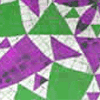
Lafayette
What mathematical words can be used to describe this floor covering? How many different shapes can you see inside this photograph?
Coordinating Classroom Coordinates
This article describes a practical approach to enhance the teaching and learning of coordinates.
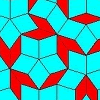
Shaping up with Tessellations
This article describes the scope for practical exploration of tessellations both in and out of the classroom. It seems a golden opportunity to link art with maths, allowing the creative side of your children to take over.

Transforming the Letters
What happens to these capital letters when they are rotated through one half turn, or flipped sideways and from top to bottom?
Penta Play
A shape and space game for 2, 3 or 4 players. Be the last person to be able to place a pentomino piece on the playing board.
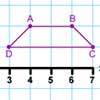
Transformation Tease
What are the coordinates of this shape after it has been transformed in the ways described? Compare these with the original coordinates. What do you notice about the numbers?
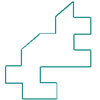
Same Shapes
How can these shapes be cut in half to make two shapes the same shape and size? Can you find more than one way to do it?
Star Find
Can you see which tile is the odd one out in this design? Using the basic tile, can you make a repeating pattern to decorate our wall?

Clock Hands
This investigation explores using different shapes as the hands of the clock. What things occur as the the hands move.