 Links to the NRICH website Home page

30 April (Primary), 1 May (Secondary)
Resources tagged with: Compound transformations
There are 11 results
Broad Topics > Transformations and constructions > Compound transformations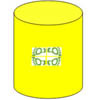
Paint Rollers for Frieze Patterns.
Proofs that there are only seven frieze patterns involve complicated group theory. The symmetries of a cylinder provide an easier approach.
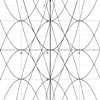
Which Quadratic?
This task develops knowledge of transformation of graphs. By framing and asking questions a member of the team has to find out which mathematical function they have chosen.


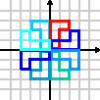
Grouping Transformations
An introduction to groups using transformations, following on from the October 2006 Stage 3 problems.


Reflect Again
Follow hints to investigate the matrix which gives a reflection of the plane in the line y=tanx. Show that the combination of two reflections in intersecting lines is a rotation.

Rots and Refs
Follow hints using a little coordinate geometry, plane geometry and trig to see how matrices are used to work on transformations of the plane.
The Use of Mathematics in Computer Games
An account of how mathematics is used in computer games including geometry, vectors, transformations, 3D graphics, graph theory and simulations.
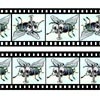
The Frieze Tree
Patterns that repeat in a line are strangely interesting. How many types are there and how do you tell one type from another?
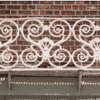
Frieze Patterns in Cast Iron
A gallery of beautiful photos of cast ironwork friezes in Australia with a mathematical discussion of the classification of frieze patterns.
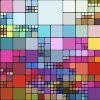
Squaring the Rectangle
Can you find a way to turn a rectangle into a square?
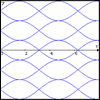
Sine Problem
In this 'mesh' of sine graphs, one of the graphs is the graph of the sine function. Find the equations of the other graphs to reproduce the pattern.