 Links to the NRICH website Home page

30 April (Primary), 1 May (Secondary)
Resources tagged with: Angles in polygons
There are 24 results
Broad Topics > Angles, polygons, and geometrical proof > Angles in polygons
Isosceles Seven
Is it possible to find the angles in this rather special isosceles triangle?



Cyclic Quadrilaterals
Draw some quadrilaterals on a 9-point circle and work out the angles. Is there a theorem?
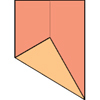

Semi-regular Tessellations
Semi-regular tessellations combine two or more different regular polygons to fill the plane. Can you find all the semi-regular tessellations?
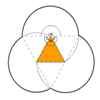
Triangles and Petals
An equilateral triangle rotates around regular polygons and produces an outline like a flower. What are the perimeters of the different flowers?
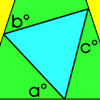
Terminology
Given an equilateral triangle inside an isosceles triangle, can you find a relationship between the angles?

Angles in Three Squares
Drawing the right diagram can help you to prove a result about the angles in a line of squares.
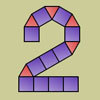

LOGO Challenge 4 - Squares to Procedures
This LOGO Challenge emphasises the idea of breaking down a problem into smaller manageable parts. Working on squares and angles.

Logo Challenge 3 - Star Square
Creating designs with squares - using the REPEAT command in LOGO. This requires some careful thought on angles

First Forward Into Logo 9: Stars
Turn through bigger angles and draw stars with Logo.

First Forward Into Logo 7: Angles of Polygons
More Logo for beginners. Learn to calculate exterior angles and draw regular polygons using procedures and variables.
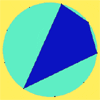
Pegboard Quads
Make different quadrilaterals on a nine-point pegboard, and work out their angles. What do you notice?

Pentakite
Given a regular pentagon, can you find the distance between two non-adjacent vertices?
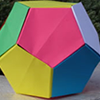
Dodecawhat
Follow instructions to fold sheets of A4 paper into pentagons and assemble them to form a dodecahedron. Calculate the error in the angle of the not perfectly regular pentagons you make.
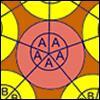
Arclets Explained
This article gives an wonderful insight into students working on the Arclets problem that first appeared in the Sept 2002 edition of the NRICH website.
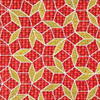
Pent
The diagram shows a regular pentagon with sides of unit length. Find all the angles in the diagram. Prove that the quadrilateral shown in red is a rhombus.
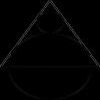
Tricircle
The centre of the larger circle is at the midpoint of one side of an equilateral triangle and the circle touches the other two sides of the triangle. A smaller circle touches the larger circle and two sides of the triangle. If the small circle has radius 1 unit find the radius of the larger circle.
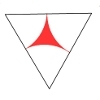
Floored
A floor is covered by a tessellation of equilateral triangles, each having three equal arcs inside it. What proportion of the area of the tessellation is shaded?

A Sameness Surely
Triangle ABC has a right angle at C. ACRS and CBPQ are squares. ST and PU are perpendicular to AB produced. Show that ST + PU = AB

No Right Angle Here
Prove that the internal angle bisectors of a triangle will never be perpendicular to each other.

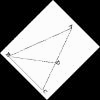
Golden Triangle
Three triangles ABC, CBD and ABD (where D is a point on AC) are all isosceles. Find all the angles. Prove that the ratio of AB to BC is equal to the golden ratio.
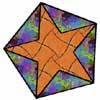
At a Glance
The area of a regular pentagon looks about twice as a big as the pentangle star drawn within it. Is it?