 Links to the NRICH website Home page

30 April (Primary), 1 May (Secondary)
Resources tagged with: 2D representations of 3D shapes
There are 29 results
Broad Topics > 3D geometry, shape and space > 2D representations of 3D shapes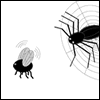
The Spider and the Fly
A spider is sitting in the middle of one of the smallest walls in a room and a fly is resting beside the window. What is the shortest distance the spider would have to crawl to catch the fly?



Nine Colours
Can you use small coloured cubes to make a 3 by 3 by 3 cube so that each face of the bigger cube contains one of each colour?
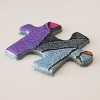
Nicola's Jigsaw
Nicola has lost a piece of her 3D jigsaw. Can you work out the shape of the missing piece?
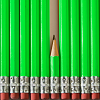
Which Face?
Which faces are opposite each other when this net is folded into a cube?
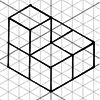
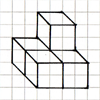


3D Drawing
The design technology curriculum requires students to be able to represent 3-dimensional objects on paper. This article introduces some of the mathematical ideas which underlie such methods.
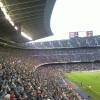
Stadium Sightline
How would you design the tiering of seats in a stadium so that all spectators have a good view?
Chopped Dice
Can you make a new type of fair die with 14 faces by shaving the corners off a cube?
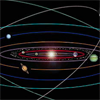
Construct the Solar System
Make an accurate diagram of the solar system and explore the concept of a grand conjunction.
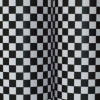
Moving Squares
How can you represent the curvature of a cylinder on a flat piece of paper?
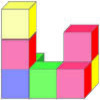
Solids
A task which depends on members of the group working collaboratively to reach a single goal.
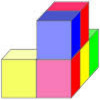
The Solid
A task which depends on members of the group working collaboratively to reach a single goal.
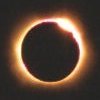
Perfect Eclipse
Use trigonometry to determine whether solar eclipses on earth can be perfect.
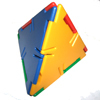
Air Nets
Can you visualise whether these nets fold up into 3D shapes? Watch the videos each time to see if you were correct.

The Perforated Cube
A cube is made from smaller cubes, 5 by 5 by 5, then some of those cubes are removed. Can you make the specified shapes, and what is the most and least number of cubes required ?

Shaping the Universe II - the Solar System
The second in a series of articles on visualising and modelling shapes in the history of astronomy.
Shaping the Universe I - Planet Earth
This article explores ths history of theories about the shape of our planet. It is the first in a series of articles looking at the significance of geometric shapes in the history of astronomy.
Pupils' Recording or Pupils Recording
This article, written for teachers, looks at the different kinds of recordings encountered in Primary Mathematics lessons and the importance of not jumping to conclusions!
The Development of Spatial and Geometric Thinking: 5 to 18
This is the first article in a series which aim to provide some insight into the way spatial thinking develops in children, and draw on a range of reported research. The focus of this article is the work of Piaget and Inhelder.

Thinking 3D
How can we as teachers begin to introduce 3D ideas to young children? Where do they start? How can we lay the foundations for a later enthusiasm for working in three dimensions?
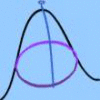
Geometry and Gravity 1
This article (the first of two) contains ideas for investigations. Space-time, the curvature of space and topology are introduced with some fascinating problems to explore.

Christmas Boxes
Find all the ways to cut out a 'net' of six squares that can be folded into a cube.

Icosian Game
This problem is about investigating whether it is possible to start at one vertex of a platonic solid and visit every other vertex once only returning to the vertex you started at.
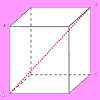
Cutting a Cube
A half-cube is cut into two pieces by a plane through the long diagonal and at right angles to it. Can you draw a net of these pieces? Are they identical?
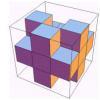
Take Ten
Is it possible to remove ten unit cubes from a 3 by 3 by 3 cube so that the surface area of the remaining solid is the same as the surface area of the original?
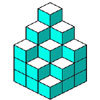
Soma - So Good
Can you mentally fit the 7 SOMA pieces together to make a cube? Can you do it in more than one way?