

Resources tagged with: Polyhedra
There are 25 results
Broad Topics > 3D geometry, shape and space > Polyhedra
Guess What?
Can you find out which 3D shape your partner has chosen before they work out your shape?


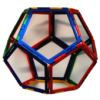
Which Solids Can We Make?
Interior angles can help us to work out which polygons will tessellate. Can we use similar ideas to predict which polygons combine to create semi-regular solids?
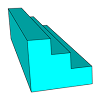
Which Solid?
This task develops spatial reasoning skills. By framing and asking questions a member of the team has to find out what mathematical object they have chosen.

Next Size Up
The challenge for you is to make a string of six (or more!) graded cubes.
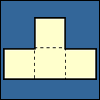
Cut Nets
Each of the nets of nine solid shapes has been cut into two pieces. Can you see which pieces go together?
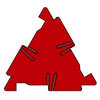
Triangles to Tetrahedra
Imagine you have an unlimited number of four types of triangle. How many different tetrahedra can you make?

Going Deeper: Achieving Greater Depth with Geometry
This article for Primary teachers outlines how providing opportunities to engage with increasingly complex problems, and to communicate thinking, can help learners 'go deeper' with geometry.

Let's Get Flexible with Geometry
In this article for primary teachers, Ems explores ways to develop mathematical flexibility through geometry.
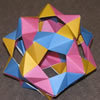
Modular Origami Polyhedra
These models have appeared around the Centre for Mathematical Sciences. Perhaps you would like to try to make some similar models of your own.
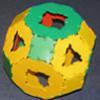
Platonic and Archimedean Solids
In a recent workshop, students made these solids. Can you think of reasons why I might have grouped the solids in the way I have before taking the pictures?
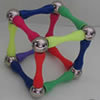
Magnetic Personality
60 pieces and a challenge. What can you make and how many of the pieces can you use creating skeleton polyhedra?
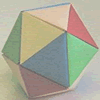
Paper Folding - Models of the Platonic Solids
A description of how to make the five Platonic solids out of paper.

Thinking 3D
How can we as teachers begin to introduce 3D ideas to young children? Where do they start? How can we lay the foundations for a later enthusiasm for working in three dimensions?
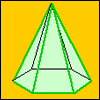
A Chain of Eight Polyhedra
Can you arrange the shapes in a chain so that each one shares a face (or faces) that are the same shape as the one that follows it?
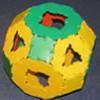
Classifying Solids Using Angle Deficiency
Toni Beardon has chosen this article introducing a rich area for practical exploration and discovery in 3D geometry

Icosian Game
This problem is about investigating whether it is possible to start at one vertex of a platonic solid and visit every other vertex once only returning to the vertex you started at.
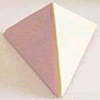
Child's Play
A toy has a regular tetrahedron, a cube and a base with triangular and square hollows. If you fit a shape into the correct hollow a bell rings. How many times does the bell ring in a complete game?
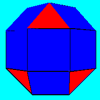
Rhombicubocts
Each of these solids is made up with 3 squares and a triangle around each vertex. Each has a total of 18 square faces and 8 faces that are equilateral triangles. How many faces, edges and vertices does each solid have?
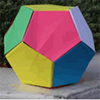
Dodecamagic
Here you see the front and back views of a dodecahedron. Each vertex has been numbered so that the numbers around each pentagonal face add up to 65. Can you find all the missing numbers?
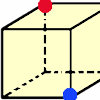
Redblue
Investigate the number of paths you can take from one vertex to another in these 3D shapes. Is it possible to take an odd number and an even number of paths to the same vertex?
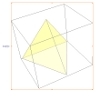
A Mean Tetrahedron
Can you number the vertices, edges and faces of a tetrahedron so that the number on each edge is the mean of the numbers on the adjacent vertices and the mean of the numbers on the adjacent faces?
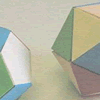
Face Painting
You want to make each of the 5 Platonic solids and colour the faces so that, in every case, no two faces which meet along an edge have the same colour.
Tetrahedron Faces
One face of a regular tetrahedron is painted blue and each of the remaining faces are painted using one of the colours red, green or yellow. How many different possibilities are there?