 Links to the NRICH website Home page

30 April (Primary), 1 May (Secondary)
Resources tagged with: Circle properties and circle theorems
There are 34 results
Broad Topics > Angles, polygons, and geometrical proof > Circle properties and circle theorems
Cyclic Quadrilaterals
Draw some quadrilaterals on a 9-point circle and work out the angles. Is there a theorem?


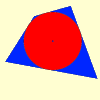
Circles in Quadrilaterals
Explore when it is possible to construct a circle which just touches all four sides of a quadrilateral.
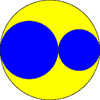
Partly Circles
What is the same and what is different about these circle questions? What connections can you make?

Right Angles
Can you make a right-angled triangle on this peg-board by joining up three points round the edge?

Subtended Angles
What is the relationship between the angle at the centre and the angles at the circumference, for angles which stand on the same arc? Can you prove it?

Triangles in Circles
Can you find triangles on a 9-point circle? Can you work out their angles?
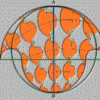
Salinon
This shape comprises four semi-circles. What is the relationship between the area of the shaded region and the area of the circle on AB as diameter?
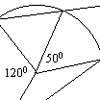
Lens Angle
Find the missing angle between the two secants to the circle when the two angles at the centre subtended by the arcs created by the intersections of the secants and the circle are 50 and 120 degrees.

Sitting Pretty
A circle of radius r touches two sides of a right angled triangle, sides x and y, and has its centre on the hypotenuse. Can you prove the formula linking x, y and r?

Compare Areas
Which has the greatest area, a circle or a square, inscribed in an isosceles right angle triangle?
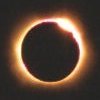
Perfect Eclipse
Use trigonometry to determine whether solar eclipses on earth can be perfect.
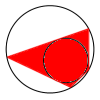
Bicentric Quadrilaterals
Investigate the properties of quadrilaterals which can be drawn with a circle just touching each side and another circle just touching each vertex.
Circle Theorems
This set of resources for teachers offers interactive environments which support work on properties of angles in circles at Key Stage 4.
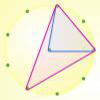
Interacting with the Geometry of the Circle
Jennifer Piggott and Charlie Gilderdale describe a free interactive circular geoboard environment that can lead learners to pose mathematical questions.
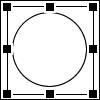
Circle Scaling
Describe how to construct three circles which have areas in the ratio 1:2:3.
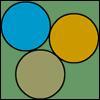
Circle Box
It is obvious that we can fit four circles of diameter 1 unit in a square of side 2 without overlapping. What is the smallest square into which we can fit 3 circles of diameter 1 unit?
Arrh!
Triangle ABC is equilateral. D, the midpoint of BC, is the centre of the semi-circle whose radius is R which touches AB and AC, as well as a smaller circle with radius r which also touches AB and AC. What is the value of r/R?
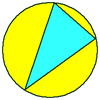
Circumnavigation
The sides of a triangle are 25, 39 and 40 units of length. Find the diameter of the circumscribed circle.
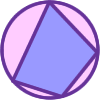
The Cyclic Quadrilateral
This gives a short summary of the properties and theorems of cyclic quadrilaterals and links to some practical examples to be found elsewhere on the site.
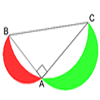
Crescents and Triangles
Can you find a relationship between the area of the crescents and the area of the triangle?
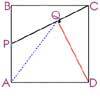
Similarly So
ABCD is a square. P is the midpoint of AB and is joined to C. A line from D perpendicular to PC meets the line at the point Q. Prove AQ = AD.
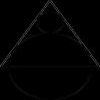
Tricircle
The centre of the larger circle is at the midpoint of one side of an equilateral triangle and the circle touches the other two sides of the triangle. A smaller circle touches the larger circle and two sides of the triangle. If the small circle has radius 1 unit find the radius of the larger circle.
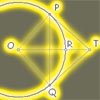
Three Balls
A circle has centre O and angle POR = angle QOR. Construct tangents at P and Q meeting at T. Draw a circle with diameter OT. Do P and Q lie inside, or on, or outside this circle?
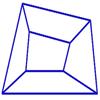
Cyclic Quad Jigsaw
A picture is made by joining five small quadrilaterals together to make a large quadrilateral. Is it possible to draw a similar picture if all the small quadrilaterals are cyclic?
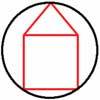
Encircling
An equilateral triangle is sitting on top of a square. What is the radius of the circle that circumscribes this shape?
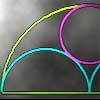
Three Four Five
Two semi-circles (each of radius 1/2) touch each other, and a semi-circle of radius 1 touches both of them. Find the radius of the circle which touches all three semi-circles.
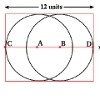
Not So Little X
Two circles are enclosed by a rectangle 12 units by x units. The distance between the centres of the two circles is x/3 units. How big is x?

Coins on a Plate
Points A, B and C are the centres of three circles, each one of which touches the other two. Prove that the perimeter of the triangle ABC is equal to the diameter of the largest circle.
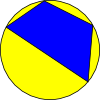
Long Short
What can you say about the lengths of the sides of a quadrilateral whose vertices are on a unit circle?
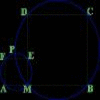
Circumspection
M is any point on the line AB. Squares of side length AM and MB are constructed and their circumcircles intersect at P (and M). Prove that the lines AD and BE produced pass through P.
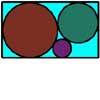
Medallions
Three circular medallions fit in a rectangular box. Can you find the radius of the largest one?
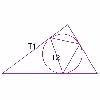
Triangle Incircle Iteration
Keep constructing triangles in the incircle of the previous triangle. What happens?
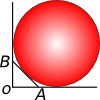
Some(?) of the Parts
A circle touches the lines OA, OB and AB where OA and OB are perpendicular. Show that the diameter of the circle is equal to the perimeter of the triangle