 Links to the NRICH website Home page

30 April (Primary), 1 May (Secondary)
Resources tagged with: Topology
There are 20 results
Broad Topics > Decision mathematics and combinatorics > Topology
A Curious Collection of Bridges
Read about the problem that tickled Euler's curiosity and led to a new branch of mathematics!
Colouring Curves Game
In this game, try not to colour two adjacent regions the same colour. Can you work out a strategy?



Symmetric Tangles
The tangles created by the twists and turns of the Conway rope trick are surprisingly symmetrical. Here's why!
Tangles
A personal investigation of Conway's Rational Tangles. What were the interesting questions that needed to be asked, and where did they lead?
Making Maths: Walking Through a Playing Card?
It might seem impossible but it is possible. How can you cut a playing card to make a hole big enough to walk through?
Going Places with Mathematicians
This article looks at the importance in mathematics of representing places and spaces mathematics. Many famous mathematicians have spent time working on problems that involve moving and mapping things.

Bands and Bridges: Bringing Topology Back
Lyndon Baker describes how the Mobius strip and Euler's law can introduce pupils to the idea of topology.

More on Mazes
There is a long tradition of creating mazes throughout history and across the world. This article gives details of mazes you can visit and those that you can tackle on paper.
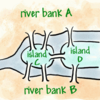
The Konigsberg Bridge Problem
This article for pupils describes the famous Konigsberg Bridge problem.
The Development of Spatial and Geometric Thinking: 5 to 18
This is the first article in a series which aim to provide some insight into the way spatial thinking develops in children, and draw on a range of reported research. The focus of this article is the work of Piaget and Inhelder.

A-maze-ing
Did you know that ancient traditional mazes often tell a story? Remembering the story helps you to draw the maze.

The Bridges of Konigsberg
Investigate how networks can be used to solve a problem for the 18th Century inhabitants of Konigsberg.

Tourism
If you can copy a network without lifting your pen off the paper and without drawing any line twice, then it is traversable. Decide which of these diagrams are traversable.
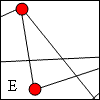
Travelling Salesman
A Hamiltonian circuit is a continuous path in a graph that passes through each of the vertices exactly once and returns to the start. How many Hamiltonian circuits can you find in these graphs?
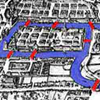
Königsberg
Can you cross each of the seven bridges that join the north and south of the river to the two islands, once and once only, without retracing your steps?
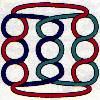
Links and Knots
Some puzzles requiring no knowledge of knot theory, just a careful inspection of the patterns. A glimpse of the classification of knots, prime knots, crossing numbers and knot arithmetic.
Geometry and Gravity 2
This is the second of two articles and discusses problems relating to the curvature of space, shortest distances on surfaces, triangulations of surfaces and representation by graphs.
Geometry and Gravity 1
This article (the first of two) contains ideas for investigations. Space-time, the curvature of space and topology are introduced with some fascinating problems to explore.

Icosian Game
This problem is about investigating whether it is possible to start at one vertex of a platonic solid and visit every other vertex once only returning to the vertex you started at.