 Links to the NRICH website Home page

30 April (Primary), 1 May (Secondary)
Resources tagged with: Visualising and representing
There are 257 results
Broad Topics > Thinking mathematically > Visualising and representing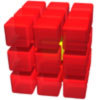
Cubes Within Cubes Revisited
Imagine starting with one yellow cube and covering it all over with a single layer of red cubes, and then covering that cube with a layer of blue cubes. How many red and blue cubes would you need?

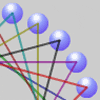
Stars
Can you work out what step size to take to ensure you visit all the dots on the circle?


Square Coordinates
A tilted square is a square with no horizontal sides. Can you devise a general instruction for the construction of a square when you are given just one of its sides?
Isosceles Triangles
Draw some isosceles triangles with an area of $9$cm$^2$ and a vertex at (20,20). If all the vertices must have whole number coordinates, how many is it possible to draw?

Efficient Cutting
Use a single sheet of A4 paper and make a cylinder having the greatest possible volume. The cylinder must be closed off by a circle at each end.
Fence It
If you have only 40 metres of fencing available, what is the maximum area of land you can fence off?
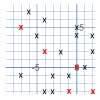
Ten Hidden Squares
These points all mark the vertices (corners) of ten hidden squares. Can you find the 10 hidden squares?
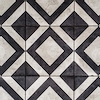
Square It
Players take it in turns to choose a dot on the grid. The winner is the first to have four dots that can be joined to form a square.

On the Edge
If you move the tiles around, can you make squares with different coloured edges?

Cuboids
Can you find a cuboid that has a surface area of exactly 100 square units. Is there more than one? Can you find them all?
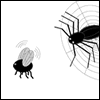
The Spider and the Fly
A spider is sitting in the middle of one of the smallest walls in a room and a fly is resting beside the window. What is the shortest distance the spider would have to crawl to catch the fly?
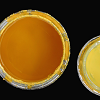
Painted Cube
Imagine a large cube made from small red cubes being dropped into a pot of yellow paint. How many of the small cubes will have yellow paint on their faces?

Buses
A bus route has a total duration of 40 minutes. Every 10 minutes, two buses set out, one from each end. How many buses will one bus meet on its way from one end to the other end?

Coordinate Patterns
Charlie and Alison have been drawing patterns on coordinate grids. Can you picture where the patterns lead?

Seven Squares - Group-worthy Task
Choose a couple of the sequences. Try to picture how to make the next, and the next, and the next... Can you describe your reasoning?

Your Number Is...
Think of a number and follow the machine's instructions... I know what your number is! Can you explain how I know?
Shear Magic
Explore the area of families of parallelograms and triangles. Can you find rules to work out the areas?
Perfectly Square
The sums of the squares of three related numbers is also a perfect square - can you explain why?
More Number Pyramids
When number pyramids have a sequence on the bottom layer, some interesting patterns emerge...

Picturing Square Numbers
Square numbers can be represented as the sum of consecutive odd numbers. What is the sum of 1 + 3 + ..... + 149 + 151 + 153?

Picturing Triangular Numbers
Triangular numbers can be represented by a triangular array of squares. What do you notice about the sum of identical triangle numbers?

Rolling Around
A circle rolls around the outside edge of a square so that its circumference always touches the edge of the square. Can you describe the locus of the centre of the circle?

Always Perfect
Show that if you add 1 to the product of four consecutive numbers the answer is ALWAYS a perfect square.

John's Train Is on Time
A train leaves on time. After it has gone 8 miles (at 33mph) the driver looks at his watch and sees that the hour hand is exactly over the minute hand. When did the train leave the station?

Shady Symmetry
How many different symmetrical shapes can you make by shading triangles or squares?

Pick's Theorem
Polygons drawn on square dotty paper have dots on their perimeter (p) and often internal (i) ones as well. Find a relationship between p, i and the area of the polygons.
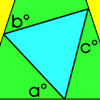
Terminology
Given an equilateral triangle inside an isosceles triangle, can you find a relationship between the angles?
Reflecting Squarely
In how many ways can you fit all three pieces together to make shapes with line symmetry?

Remainders
I'm thinking of a number. My number is both a multiple of 5 and a multiple of 6. What could my number be?
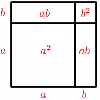
Proofs with Pictures
Some diagrammatic 'proofs' of algebraic identities and inequalities.

Frogs
How many moves does it take to swap over some red and blue frogs? Do you have a method?

Think of Two Numbers
Think of two whole numbers under 10, and follow the steps. I can work out both your numbers very quickly. How?
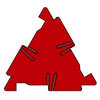
Triangles to Tetrahedra
Imagine you have an unlimited number of four types of triangle. How many different tetrahedra can you make?
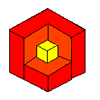
Cubes Within Cubes
We start with one yellow cube and build around it to make a 3x3x3 cube with red cubes. Then we build around that red cube with blue cubes and so on. How many cubes of each colour have we used?


Attractive Tablecloths
Charlie likes tablecloths that use as many colours as possible, but insists that his tablecloths have some symmetry. Can you work out how many colours he needs for different tablecloth designs?

Marbles in a Box
How many winning lines can you make in a three-dimensional version of noughts and crosses?

Iff
Take a triangular number, multiply it by 8 and add 1. What is special about your answer? Can you prove it?

Nine Colours
Can you use small coloured cubes to make a 3 by 3 by 3 cube so that each face of the bigger cube contains one of each colour?

Funny Factorisation
Using the digits 1 to 9, the number 4396 can be written as the product of two numbers. Can you find the factors?
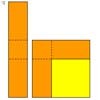
Plus Minus
Can you explain the surprising results Jo found when she calculated the difference between square numbers?

One and Three
Two motorboats travelling up and down a lake at constant speeds leave opposite ends A and B at the same instant, passing each other, for the first time 600 metres from A, and on their return, 400 metres from B. How long is the lake?
Legs Eleven
Take any four digit number. Move the first digit to the end and move the rest along. Now add your two numbers. Did you get a multiple of 11?
Doesn't Add Up
In this problem we are faced with an apparently easy area problem, but it has gone horribly wrong! What happened?

Is There a Theorem?
Draw a square. A second square of the same size slides around the first always maintaining contact and keeping the same orientation. How far does the dot travel?
Counting Factors
Is there an efficient way to work out how many factors a large number has?
Picture Story
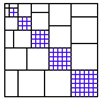
Can you see how this picture illustrates the formula for the sum of the first six cube numbers?

Bendy Quad
Four rods are hinged at their ends to form a convex quadrilateral. Investigate the different shapes that the quadrilateral can take. Be patient this problem may be slow to load.