 Links to the NRICH website Home page

30 April (Primary), 1 May (Secondary)
Resources tagged with: Visualising and representing
There are 335 results
Broad Topics > Thinking mathematically > Visualising and representing
Fence It
If you have only 40 metres of fencing available, what is the maximum area of land you can fence off?


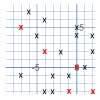
Ten Hidden Squares
These points all mark the vertices (corners) of ten hidden squares. Can you find the 10 hidden squares?
Square It
Players take it in turns to choose a dot on the grid. The winner is the first to have four dots that can be joined to form a square.

On the Edge
If you move the tiles around, can you make squares with different coloured edges?
Hundred Square
A hundred square has been printed on both sides of a piece of paper. What is on the back of 100? 58? 23? 19?

Cuboids
Can you find a cuboid that has a surface area of exactly 100 square units. Is there more than one? Can you find them all?
Cut Nets
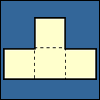
Each of the nets of nine solid shapes has been cut into two pieces. Can you see which pieces go together?

Buses
A bus route has a total duration of 40 minutes. Every 10 minutes, two buses set out, one from each end. How many buses will one bus meet on its way from one end to the other end?

Coordinate Patterns
Charlie and Alison have been drawing patterns on coordinate grids. Can you picture where the patterns lead?
Seven Squares - Group-worthy Task
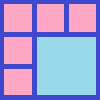
Choose a couple of the sequences. Try to picture how to make the next, and the next, and the next... Can you describe your reasoning?

Your Number Is...
Think of a number and follow the machine's instructions... I know what your number is! Can you explain how I know?

Shear Magic
Explore the area of families of parallelograms and triangles. Can you find rules to work out the areas?
More Number Pyramids
When number pyramids have a sequence on the bottom layer, some interesting patterns emerge...

Odd Squares
Think of a number, square it and subtract your starting number. Is the number you're left with odd or even? How do the images help to explain this?
Picturing Square Numbers
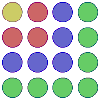
Square numbers can be represented as the sum of consecutive odd numbers. What is the sum of 1 + 3 + ..... + 149 + 151 + 153?

Picturing Triangular Numbers
Triangular numbers can be represented by a triangular array of squares. What do you notice about the sum of identical triangle numbers?

Rolling Around
A circle rolls around the outside edge of a square so that its circumference always touches the edge of the square. Can you describe the locus of the centre of the circle?

Sponge Sections
You have been given three shapes made out of sponge: a sphere, a cylinder and a cone. Your challenge is to find out how to cut them to make different shapes for printing.
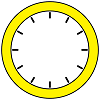
A Mixed-up Clock
There is a clock-face where the numbers have become all mixed up. Can you find out where all the numbers have got to from these ten statements?
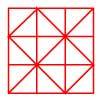
Fractional Triangles
Use the lines on this figure to show how the square can be divided into 2 halves, 3 thirds, 6 sixths and 9 ninths.
John's Train Is on Time
A train leaves on time. After it has gone 8 miles (at 33mph) the driver looks at his watch and sees that the hour hand is exactly over the minute hand. When did the train leave the station?
The Deca Tree
Find out what a Deca Tree is and then work out how many leaves there will be after the woodcutter has cut off a trunk, a branch, a twig and a leaf.
Trebling
Can you replace the letters with numbers? Is there only one solution in each case?

Let Us Reflect
Where can you put the mirror across the square so that you can still "see" the whole square? How many different positions are possible?

Shady Symmetry
How many different symmetrical shapes can you make by shading triangles or squares?
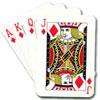
Counting Cards
A magician took a suit of thirteen cards and held them in his hand face down. Every card he revealed had the same value as the one he had just finished spelling. How did this work?
Reflecting Squarely
In how many ways can you fit all three pieces together to make shapes with line symmetry?

Remainders
I'm thinking of a number. My number is both a multiple of 5 and a multiple of 6. What could my number be?

Frogs
How many moves does it take to swap over some red and blue frogs? Do you have a method?

Think of Two Numbers
Think of two whole numbers under 10, and follow the steps. I can work out both your numbers very quickly. How?
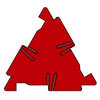
Triangles to Tetrahedra
Imagine you have an unlimited number of four types of triangle. How many different tetrahedra can you make?
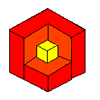
Cubes Within Cubes
We start with one yellow cube and build around it to make a 3x3x3 cube with red cubes. Then we build around that red cube with blue cubes and so on. How many cubes of each colour have we used?
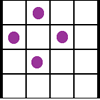
Square Corners
What is the greatest number of counters you can place on the grid below without four of them lying at the corners of a square?
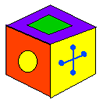
A Puzzling Cube
Here are the six faces of a cube - in no particular order. Here are three views of the cube. Can you deduce where the faces are in relation to each other and record them on the net of this cube?

Reach 100
Choose four different digits from 1-9 and put one in each box so that the resulting four two-digit numbers add to a total of 100.
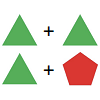
Super Shapes
The value of the circle changes in each of the following problems. Can you discover its value in each problem?
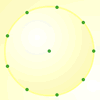
Quadrilaterals
How many DIFFERENT quadrilaterals can be made by joining the dots on the 8-point circle?

Marbles in a Box
How many winning lines can you make in a three-dimensional version of noughts and crosses?
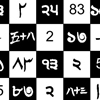
Which Scripts?
There are six numbers written in five different scripts. Can you sort out which is which?

Nine Colours
Can you use small coloured cubes to make a 3 by 3 by 3 cube so that each face of the bigger cube contains one of each colour?

Funny Factorisation
Using the digits 1 to 9, the number 4396 can be written as the product of two numbers. Can you find the factors?
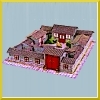
Neighbours
In a square in which the houses are evenly spaced, numbers 3 and 10 are opposite each other. What is the smallest and what is the largest possible number of houses in the square?
Legs Eleven
Take any four digit number. Move the first digit to the end and move the rest along. Now add your two numbers. Did you get a multiple of 11?
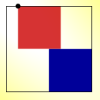
Is There a Theorem?
Draw a square. A second square of the same size slides around the first always maintaining contact and keeping the same orientation. How far does the dot travel?
Counting Factors
Is there an efficient way to work out how many factors a large number has?
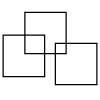
Three Squares
What is the greatest number of squares you can make by overlapping three squares?

Four Triangles Puzzle
Cut four triangles from a square as shown in the picture. How many different shapes can you make by fitting the four triangles back together?

Sweets in a Box
How many different shaped boxes can you design for 36 sweets in one layer? Can you arrange the sweets so that no sweets of the same colour are next to each other in any direction?
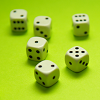
Roll These Dice
Roll two red dice and a green dice. Add the two numbers on the red dice and take away the number on the green. What are all the different possible answers?