 Links to the NRICH website Home page

30 April (Primary), 1 May (Secondary)
Resources tagged with: Visualising and representing
There are 230 results
Broad Topics > Thinking mathematically > Visualising and representing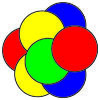
Counters in the Middle
This task depends on groups working collaboratively, discussing and reasoning to agree a final product.


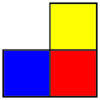
Arranging Cubes
A task which depends on members of the group working collaboratively to reach a single goal.
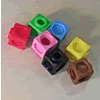
How Many?
This project challenges you to work out the number of cubes hidden under a cloth. What questions would you like to ask?
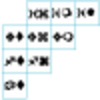
Coded Hundred Square
This 100 square jigsaw is written in code. It starts with 1 and ends with 100. Can you build it up?
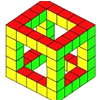
Holes
I've made some cubes and some cubes with holes in. This challenge invites you to explore the difference in the number of small cubes I've used. Can you see any patterns?
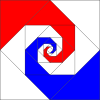
Baravelle
What can you see? What do you notice? What questions can you ask?
Treasure Hunt
Can you find a reliable strategy for choosing coordinates that will locate the treasure in the minimum number of guesses?
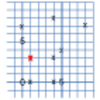
Eight Hidden Squares
On the graph there are 28 marked points. These points all mark the vertices (corners) of eight hidden squares. Can you find the eight hidden squares?
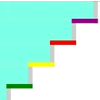
Swimming Pool
In this problem, we're investigating the number of steps we would climb up or down to get out of or into the swimming pool. How could you number the steps below the water?
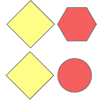
Overlapping Again
What shape is the overlap when you slide one of these shapes half way across another? Can you picture it in your head? Use the interactivity to check your visualisation.
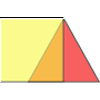
Overlaps
What does the overlap of these two shapes look like? Try picturing it in your head and then use some cut-out shapes to test your prediction.
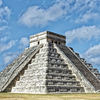
Picture a Pyramid ...
Imagine a pyramid which is built in square layers of small cubes. If we number the cubes from the top, starting with 1, can you picture which cubes are directly below this first cube?
Method in Multiplying Madness?
Watch our videos of multiplication methods that you may not have met before. Can you make sense of them?
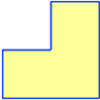
Twice as Big?
Investigate how the four L-shapes fit together to make an enlarged L-shape. You could explore this idea with other shapes too.
Music to My Ears
Can you predict when you'll be clapping and when you'll be clicking if you start this rhythm? How about when a friend begins a new rhythm at the same time?
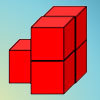
Brush Loads
How can you arrange the 5 cubes so that you need the smallest number of Brush Loads of paint to cover them? Try with other numbers of cubes as well.


Same Length Trains
How many trains can you make which are the same length as Matt's and Katie's, using rods that are identical?
Stringy Quads
This practical problem challenges you to make quadrilaterals with a loop of string. You'll need some friends to help!
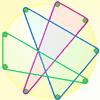
Nine-pin Triangles
How many different triangles can you make on a circular pegboard that has nine pegs?
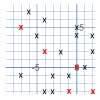
Ten Hidden Squares
These points all mark the vertices (corners) of ten hidden squares. Can you find the 10 hidden squares?

Tangram Tangle
If you split the square into these two pieces, it is possible to fit the pieces together again to make a new shape. How many new shapes can you make?
Hundred Square
A hundred square has been printed on both sides of a piece of paper. What is on the back of 100? 58? 23? 19?
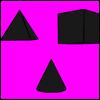
Shadow Play
Here are shadows of some 3D shapes. What shapes could have made them?
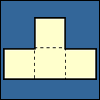
Cut Nets
Each of the nets of nine solid shapes has been cut into two pieces. Can you see which pieces go together?
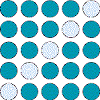
Odd Squares
Think of a number, square it and subtract your starting number. Is the number you're left with odd or even? How do the images help to explain this?

Sponge Sections
You have been given three shapes made out of sponge: a sphere, a cylinder and a cone. Your challenge is to find out how to cut them to make different shapes for printing.
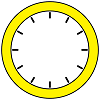
A Mixed-up Clock
There is a clock-face where the numbers have become all mixed up. Can you find out where all the numbers have got to from these ten statements?
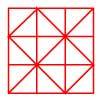
Fractional Triangles
Use the lines on this figure to show how the square can be divided into 2 halves, 3 thirds, 6 sixths and 9 ninths.
The Deca Tree
Find out what a Deca Tree is and then work out how many leaves there will be after the woodcutter has cut off a trunk, a branch, a twig and a leaf.

Eggs in Baskets
There are three baskets, a brown one, a red one and a pink one, holding a total of 10 eggs. How many eggs are in each basket?

Let Us Reflect
Where can you put the mirror across the square so that you can still "see" the whole square? How many different positions are possible?
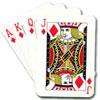
Counting Cards
A magician took a suit of thirteen cards and held them in his hand face down. Every card he revealed had the same value as the one he had just finished spelling. How did this work?

Remainders
I'm thinking of a number. My number is both a multiple of 5 and a multiple of 6. What could my number be?
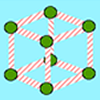
Skeleton Shapes
How many balls of modelling clay and how many straws does it take to make these skeleton shapes?
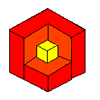
Cubes Within Cubes
We start with one yellow cube and build around it to make a 3x3x3 cube with red cubes. Then we build around that red cube with blue cubes and so on. How many cubes of each colour have we used?
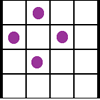
Square Corners
What is the greatest number of counters you can place on the grid below without four of them lying at the corners of a square?
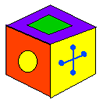
A Puzzling Cube
Here are the six faces of a cube - in no particular order. Here are three views of the cube. Can you deduce where the faces are in relation to each other and record them on the net of this cube?
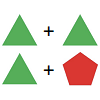
Super Shapes
The value of the circle changes in each of the following problems. Can you discover its value in each problem?
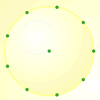
Quadrilaterals
How many DIFFERENT quadrilaterals can be made by joining the dots on the 8-point circle?
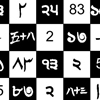
Which Scripts?
There are six numbers written in five different scripts. Can you sort out which is which?
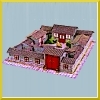
Neighbours
In a square in which the houses are evenly spaced, numbers 3 and 10 are opposite each other. What is the smallest and what is the largest possible number of houses in the square?
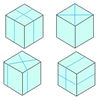
Cubes Cut Into Four Pieces
Eight children each had a cube made from modelling clay. They cut them into four pieces which were all exactly the same shape and size. Whose pieces are the same? Can you decide who made each set?
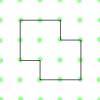
Happy Halving
Can you split each of the shapes below in half so that the two parts are exactly the same?

Catrina's Cards
How would you find out how many football cards Catrina has collected?
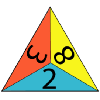
One Big Triangle
Make one big triangle so the numbers that touch on the small triangles add to 10.
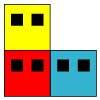
A City of Towers
In this town, houses are built with one room for each person. There are some families of seven people living in the town. In how many different ways can they build their houses?
Writing Digits
Lee was writing all the counting numbers from 1 to 20. She stopped for a rest after writing seventeen digits. What was the last number she wrote?
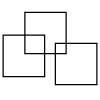
Three Squares
What is the greatest number of squares you can make by overlapping three squares?

Four Triangles Puzzle
Cut four triangles from a square as shown in the picture. How many different shapes can you make by fitting the four triangles back together?