 Links to the NRICH website Home page

30 April (Primary), 1 May (Secondary)
Resources tagged with: Arithmetic sequences
There are 15 NRICH Mathematical resources connected to Arithmetic sequences, you may find related items under Patterns, sequences and structure.
Broad Topics > Patterns, sequences and structure > Arithmetic sequences
Steel Cables
Some students have been working out the number of strands needed for different sizes of cable. Can you make sense of their solutions?



Charlie's Delightful Machine
Here is a machine with four coloured lights. Can you develop a strategy to work out the rules controlling each light?

A Little Light Thinking
Here is a machine with four coloured lights. Can you make two lights switch on at once? Three lights? All four lights?

Slick Summing
Watch the video to see how Charlie works out the sum. Can you adapt his method?

Mystic Rose
Use the animation to help you work out how many lines are needed to draw mystic roses of different sizes.
Proof Sorter - Sum of an Arithmetic Sequence
Put the steps of this proof in order to find the formula for the sum of an arithmetic sequence
Prime AP
What can you say about the common difference of an AP where every term is prime?

Speedy Summations
Watch the video to see how to add together an arithmetic sequence of numbers efficiently.

Prime Sequences
This group tasks allows you to search for arithmetic progressions in the prime numbers. How many of the challenges will you discover for yourself?

Polite Numbers
A polite number can be written as the sum of two or more consecutive positive integers, for example 8+9+10=27 is a polite number. Can you find some more polite, and impolite, numbers?

Series Sums
Let S1 = 1 , S2 = 2 + 3, S3 = 4 + 5 + 6 ,........ Calculate S17.
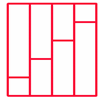
Natural Sum
The picture illustrates the sum 1 + 2 + 3 + 4 = (4 x 5)/2. Prove the general formula for the sum of the first n natural numbers and the formula for the sum of the cubes of the first n natural numbers.

Summats Clear
Find the sum, f(n), of the first n terms of the sequence: 0, 1, 1, 2, 2, 3, 3........p, p, p +1, p + 1,..... Prove that f(a + b) - f(a - b) = ab.
Janusz Asked
In y = ax +b when are a, -b/a, b in arithmetic progression. The polynomial y = ax^2 + bx + c has roots r1 and r2. Can a, r1, b, r2 and c be in arithmetic progression?
Be Reasonable
Prove that sqrt2, sqrt3 and sqrt5 cannot be terms of ANY arithmetic progression.