 Links to the NRICH website Home page

30 April (Primary), 1 May (Secondary)
Resources tagged with: Modular arithmetic
There are 39 results
Broad Topics > Properties of numbers > Modular arithmetic
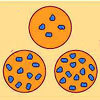
Odd Stones
On a "move" a stone is removed from two of the circles and placed in the third circle. Here are five of the ways that 27 stones could be distributed.



Guesswork
Ask a friend to choose a number between 1 and 63. By identifying which of the six cards contains the number they are thinking of it is easy to tell them what the number is.
Take Three from Five
Caroline and James pick sets of five numbers. Charlie tries to find three that add together to make a multiple of three. Can they stop him?
Prime AP
What can you say about the common difference of an AP where every term is prime?

Sixinit
Choose any whole number n, cube it, add 11n, and divide by 6. What do you notice?
Happy birthDay
Can you interpret this algorithm to determine the day on which you were born?

Zeller's Birthday
What day of the week were you born on? Do you know? Here's a way to find out.

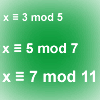
The Chinese Remainder Theorem
In this article we shall consider how to solve problems such as "Find all integers that leave a remainder of 1 when divided by 2, 3, and 5."
An Introduction to Modular Arithmetic
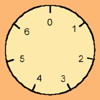
An introduction to the notation and uses of modular arithmetic

The Knapsack Problem and Public Key Cryptography
An example of a simple Public Key code, called the Knapsack Code is described in this article, alongside some information on its origins. A knowledge of modular arithmetic is useful.

Knapsack
You have worked out a secret code with a friend. Every letter in the alphabet can be represented by a binary value.
The Public Key
Find 180 to the power 59 (mod 391) to crack the code. To find the secret number with a calculator we work with small numbers like 59 and 391 but very big numbers are used in the real world for this.
Double Time
Crack this code which depends on taking pairs of letters and using two simultaneous relations and modulus arithmetic to encode the message.

Readme
Decipher a simple code based on the rule C=7P+17 (mod 26) where C is the code for the letter P from the alphabet. Rearrange the formula and use the inverse to decipher automatically.
Modular Fractions
We only need 7 numbers for modulus (or clock) arithmetic mod 7 including working with fractions. Explore how to divide numbers and write fractions in modulus arithemtic.
Transposition Fix
Suppose an operator types a US Bank check code into a machine and transposes two adjacent digits will the machine pick up every error of this type? Does the same apply to ISBN numbers; will a machine detect transposition errors in these numbers?
Check Code Sensitivity
You are given the method used for assigning certain check codes and you have to find out if an error in a single digit can be identified.
Check Codes
Details are given of how check codes are constructed (using modulus arithmetic for passports, bank accounts, credit cards, ISBN book numbers, and so on. A list of codes is given and you have to check if they are valid identification numbers?

Obviously?
Find the values of n for which 1^n + 8^n - 3^n - 6^n is divisible by 6.
Pythagoras Mod 5
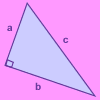
Prove that for every right angled triangle which has sides with integer lengths: (1) the area of the triangle is even and (2) the length of one of the sides is divisible by 5.

Rational Round
Show that there are infinitely many rational points on the unit circle and no rational points on the circle x^2+y^2=3.
Dirisibly Yours
Find and explain a short and neat proof that 5^(2n+1) + 11^(2n+1) + 17^(2n+1) is divisible by 33 for every non negative integer n.
The Best Card Trick?
Time for a little mathemagic! Choose any five cards from a pack and show four of them to your partner. How can they work out the fifth?

Latin Squares
A Latin square of order n is an array of n symbols in which each symbol occurs exactly once in each row and exactly once in each column.
Modulus Arithmetic and a Solution to Dirisibly Yours
Peter Zimmerman from Mill Hill County High School in Barnet, London gives a neat proof that: 5^(2n+1) + 11^(2n+1) + 17^(2n+1) is divisible by 33 for every non negative integer n.

Modulus Arithmetic and a Solution to Differences
Peter Zimmerman, a Year 13 student at Mill Hill County High School in Barnet, London wrote this account of modulus arithmetic.
Small Groups
Learn about the rules for a group and the different groups of 4 elements by doing some simple puzzles.
Grid Lockout
What remainders do you get when square numbers are divided by 4?

Euler's Officers
How many different ways can you arrange the officers in a square?

Remainder Hunt
What are the possible remainders when the 100-th power of an integer is divided by 125?

Novemberish
a) A four digit number (in base 10) aabb is a perfect square. Discuss ways of systematically finding this number. (b) Prove that 11^{10}-1 is divisible by 100.


Mod 3
Prove that if a^2+b^2 is a multiple of 3 then both a and b are multiples of 3.
Old Nuts
In turn 4 people throw away three nuts from a pile and hide a quarter of the remainder finally leaving a multiple of 4 nuts. How many nuts were at the start?

Purr-fection
What is the smallest perfect square that ends with the four digits 9009?