 Links to the NRICH website Home page

30 April (Primary), 1 May (Secondary)
Resources tagged with: Expanding and factorising quadratics
There are 36 results
Broad Topics > Algebraic expressions, equations and formulae > Expanding and factorising quadratics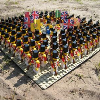
Hollow Squares
Which armies can be arranged in hollow square fighting formations?



Square Number Surprises
There are unexpected discoveries to be made about square numbers...
Difference of Two Squares
What is special about the difference between squares of numbers adjacent to multiples of three?

Pythagoras Perimeters
If you know the perimeter of a right angled triangle, what can you say about the area?
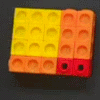
Factorising with Multilink
Can you find out what is special about the dimensions of rectangles you can make with squares, sticks and units?
Finding Factors
Can you find the hidden factors which multiply together to produce each quadratic expression?
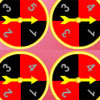
Spinners
How do scores on dice and factors of polynomials relate to each other?
Perfectly Square
The sums of the squares of three related numbers is also a perfect square - can you explain why?

Pair Products
Choose four consecutive whole numbers. Multiply the first and last numbers together. Multiply the middle pair together. What do you notice?

Always Perfect
Show that if you add 1 to the product of four consecutive numbers the answer is ALWAYS a perfect square.

Telescoping Functions
Take a complicated fraction with the product of five quartics top and bottom and reduce this to a whole number. This is a numerical example involving some clever algebra.

Number Rules - OK
Can you produce convincing arguments that a selection of statements about numbers are true?

Iff
Take a triangular number, multiply it by 8 and add 1. What is special about your answer? Can you prove it?
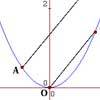
Parabella
This is a beautiful result involving a parabola and parallels.

Why 24?
Take any prime number greater than 3 , square it and subtract one. Working on the building blocks will help you to explain what is special about your results.

What's Possible?
Many numbers can be expressed as the difference of two perfect squares. What do you notice about the numbers you CANNOT make?

Fair Shares?
A mother wants to share a sum of money by giving each of her children in turn a lump sum plus a fraction of the remainder. How can she do this in order to share the money out equally?
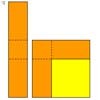
Plus Minus
Can you explain the surprising results Jo found when she calculated the difference between square numbers?

How Old Am I?
In 15 years' time my age will be the square of my age 15 years ago. Can you work out my age, and when I had other special birthdays?

Always Two
Find all the triples of numbers a, b, c such that each one of them plus the product of the other two is always 2.
2-digit Square
A 2-Digit number is squared. When this 2-digit number is reversed and squared, the difference between the squares is also a square. What is the 2-digit number?
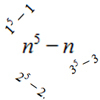
Common Divisor
Find the largest integer which divides every member of the following sequence: 1^5-1, 2^5-2, 3^5-3, ... n^5-n.

Mega Quadratic Equations
What do you get when you raise a quadratic to the power of a quadratic?

Unit Interval
Can you prove our inequality holds for all values of x and y between 0 and 1?
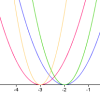
Geometric Parabola
Explore what happens when you draw graphs of quadratic equations with coefficients based on a geometric sequence.
Spot the Difference
If you plot these graphs they may look the same, but are they?

Polar Flower
This polar equation is a quadratic. Plot the graph given by each factor to draw the flower.

Multiplication Magic
Given any 3 digit number you can use the given digits and name another number which is divisible by 37 (e.g. given 628 you say 628371 is divisible by 37 because you know that 6+3 = 2+7 = 8+1 = 9). The question asks you to explain the trick.

Poly Fibs
A sequence of polynomials starts 0, 1 and each poly is given by combining the two polys in the sequence just before it. Investigate and prove results about the roots of the polys.
Fibonacci Factors
For which values of n is the Fibonacci number fn even? Which Fibonnaci numbers are divisible by 3?
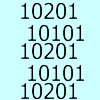
Composite Notions
A composite number is one that is neither prime nor 1. Show that 10201 is composite in any base.
Powerful Factors
Use the fact that: x²-y² = (x-y)(x+y) and x³+y³ = (x+y) (x²-xy+y²) to find the highest power of 2 and the highest power of 3 which divide 5^{36}-1.
Never Prime
If a two digit number has its digits reversed and the smaller of the two numbers is subtracted from the larger, prove the difference can never be prime.

Novemberish
a) A four digit number (in base 10) aabb is a perfect square. Discuss ways of systematically finding this number. (b) Prove that 11^{10}-1 is divisible by 100.

Code to Zero
Find all 3 digit numbers such that by adding the first digit, the square of the second and the cube of the third you get the original number, for example 1 + 3^2 + 5^3 = 135.

Two Cubes
Two cubes, each with integral side lengths, have a combined volume equal to the total of the lengths of their edges. How big are the cubes? [If you find a result by 'trial and error' you'll need to prove you have found all possible solutions.]