 Links to the NRICH website Home page

30 April (Primary), 1 May (Secondary)
Resources tagged with: Divisibility
There are 57 results
Broad Topics > Properties of numbers > Divisibility
Statement Snap
You'll need to know your number properties to win a game of Statement Snap...



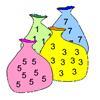
What Numbers Can We Make Now?
Imagine we have four bags containing numbers from a sequence. What numbers can we make now?

What Numbers Can We Make?
Imagine we have four bags containing a large number of 1s, 4s, 7s and 10s. What numbers can we make?
Going Round in Circles
Mathematicians are always looking for efficient methods for solving problems. How efficient can you be?

The Remainders Game
Play this game and see if you can figure out the computer's chosen number.

Power Mad!
Powers of numbers behave in surprising ways. Take a look at some of these and try to explain why they are true.

Elevenses
How many pairs of numbers can you find that add up to a multiple of 11? Do you notice anything interesting about your results?
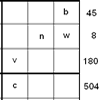
LCM Sudoku
Here is a Sudoku with a difference! Use information about lowest common multiples to help you solve it.
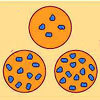
Odd Stones
On a "move" a stone is removed from two of the circles and placed in the third circle. Here are five of the ways that 27 stones could be distributed.

Ben's Game
Ben, Jack and Emma passed counters to each other and ended with the same number of counters. How many did they start with?

Peaches Today, Peaches Tomorrow...
A monkey with peaches, keeps a fraction of them each day, gives the rest away, and then eats one. How long can his peaches last?

What an Odd Fact(or)
Can you show that 1^99 + 2^99 + 3^99 + 4^99 + 5^99 is divisible by 5?
Take Three from Five
Caroline and James pick sets of five numbers. Charlie tries to find three that add together to make a multiple of three. Can they stop him?

Fac-finding
Lyndon chose this as one of his favourite problems. It is accessible but needs some careful analysis of what is included and what is not. A systematic approach is really helpful.

Remainders
I'm thinking of a number. My number is both a multiple of 5 and a multiple of 6. What could my number be?
Divisibility Tests
This article explains various divisibility rules and why they work. An article to read with pencil and paper handy.

American Billions
Play the divisibility game to create numbers in which the first two digits make a number divisible by 2, the first three digits make a number divisible by 3...

Why 24?
Take any prime number greater than 3 , square it and subtract one. Working on the building blocks will help you to explain what is special about your results.

Differences
Can you guarantee that, for any three numbers you choose, the product of their differences will always be an even number?
Expenses
What is the largest number which, when divided into 1905, 2587, 3951, 7020 and 8725 in turn, leaves the same remainder each time?

Legs Eleven
Take any four digit number. Move the first digit to the end and move the rest along. Now add your two numbers. Did you get a multiple of 11?


Big Powers
Three people chose this as a favourite problem. It is the sort of problem that needs thinking time - but once the connection is made it gives access to many similar ideas.

Counting Factors
Is there an efficient way to work out how many factors a large number has?
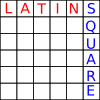
Latin Numbers
Can you create a Latin Square from multiples of a six digit number?
Check Codes
Details are given of how check codes are constructed (using modulus arithmetic for passports, bank accounts, credit cards, ISBN book numbers, and so on. A list of codes is given and you have to check if they are valid identification numbers?

Obviously?
Find the values of n for which 1^n + 8^n - 3^n - 6^n is divisible by 6.
Three Times Seven
A three digit number abc is always divisible by 7 when 2a+3b+c is divisible by 7. Why?

Just Repeat
Think of any three-digit number. Repeat the digits. The 6-digit number that you end up with is divisible by 91. Is this a coincidence?

396
The four digits 5, 6, 7 and 8 are put at random in the spaces of the number : 3 _ 1 _ 4 _ 0 _ 9 2 Calculate the probability that the answer will be a multiple of 396.

Remainder
What is the remainder when 2^2002 is divided by 7? What happens with different powers of 2?
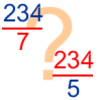
Divisively So
How many numbers less than 1000 are NOT divisible by either: a) 2 or 5; or b) 2, 5 or 7?

Powerful Factorial
6! = 6 x 5 x 4 x 3 x 2 x 1. The highest power of 2 that divides exactly into 6! is 4 since (6!) / (2^4 ) = 45. What is the highest power of two that divides exactly into 100!?
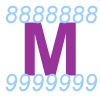
Eminit
The number 8888...88M9999...99 is divisible by 7 and it starts with the digit 8 repeated 50 times and ends with the digit 9 repeated 50 times. What is the value of the digit M?

Adding in Rows
List any 3 numbers. It is always possible to find a subset of adjacent numbers that add up to a multiple of 3. Can you explain why and prove it?

Factoring Factorials
Find the highest power of 11 that will divide into 1000! exactly.

Gaxinta
A number N is divisible by 10, 90, 98 and 882 but it is NOT divisible by 50 or 270 or 686 or 1764. It is also known that N is a factor of 9261000. What is N?
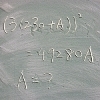
Digat
What is the value of the digit A in the sum below: [3(230 + A)]^2 = 49280A

AB Search
The five digit number A679B, in base ten, is divisible by 72. What are the values of A and B?
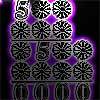
Skeleton
Amazing as it may seem the three fives remaining in the following `skeleton' are sufficient to reconstruct the entire long division sum.

Square Routes
How many four digit square numbers are composed of even numerals? What four digit square numbers can be reversed and become the square of another number?
Oh! Hidden Inside?
Find the number which has 8 divisors, such that the product of the divisors is 331776.
Repeaters
Choose any 3 digits and make a 6 digit number by repeating the 3 digits in the same order (e.g. 594594). Explain why whatever digits you choose the number will always be divisible by 7, 11 and 13.

Squaresearch
Consider numbers of the form un = 1! + 2! + 3! +...+n!. How many such numbers are perfect squares?
Sixational
The nth term of a sequence is given by the formula n^3 + 11n. Find the first four terms of the sequence given by this formula and the first term of the sequence which is bigger than one million. Prove that all terms of the sequence are divisible by 6.

Novemberish
a) A four digit number (in base 10) aabb is a perfect square. Discuss ways of systematically finding this number. (b) Prove that 11^{10}-1 is divisible by 100.

Mod 3
Prove that if a^2+b^2 is a multiple of 3 then both a and b are multiples of 3.
N000ughty Thoughts
How many noughts are at the end of these giant numbers?
Adding All Nine
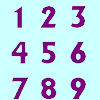
Make a set of numbers that use all the digits from 1 to 9, once and once only. Add them up. The result is divisible by 9. Add each of the digits in the new number. What is their sum? Now try some other possibilities for yourself!